
The Significance of the Japan-U.S.-Philippines 2026 South China Sea Exercise Involving the Destroyer Yudachi and USS Santa Barbara
 Tanaka Takashi
The Significance of the Japan-U.S.-Philippines 2026 South China Sea Exercise Involving the Destroyer Yudachi and USS Santa Barbara
In the announcement from the Joint Staff Office on July 25, the first thing that caught the eye was the combination of participating units. The Japan Maritime Self-Defense Force's destroyer "Yudachi," the U.S. Navy's USS Santa Barbara and P-8A, the Philippine Navy's BRP Antonio Luna, and the Philippine Air Force's C-208B, FA-50, A-29B, W-3A, along with the Coast Guard's BRP Teresa Magbanua and BRP Cape San Agustin, conducted a multilateral exercise in the South China Sea on July 24.
This is not a large-scale fleet exercise. The announced activities are simply categorized as "tactical training." However, it is precisely this simplicity that holds operational significance. The fact that the navies, air forces, and coast guards of Japan, the U.S., and the Philippines operated in the same waters can be seen as an attempt to connect peacetime monitoring, crisis communication, and deterrence in the pre-conflict phase into a single line.
A Small Formation in the South China Sea
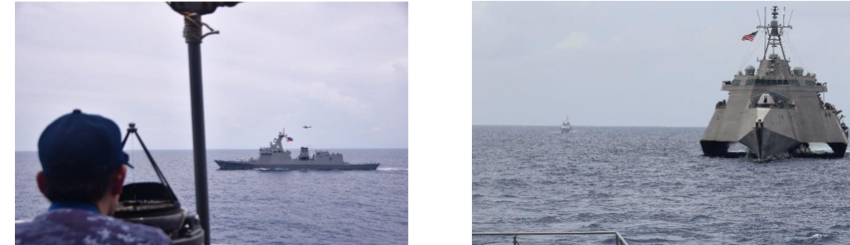
According to the Joint Staff Office, this activity demonstrates the strengthening of regional and international cooperation that supports a "free and open Indo-Pacific," confirming the freedom of navigation and overflight, as well as respect for maritime interests based on the United Nations Convention on the Law of the Sea. While the wording is diplomatic, from the perspective of the Japan Maritime Self-Defense Force, the focus is less on the freedom of navigation itself and more on the procedures for mutual identification, communication, and reducing misidentifications on-site.
The nature of the participating equipment is also suggestive. The destroyer "Yudachi" possesses basic capabilities for air defense, anti-submarine warfare, and surface combat as a general-purpose destroyer of the Japan Maritime Self-Defense Force. The U.S. P-8A is responsible for wide-area maritime surveillance and anti-submarine patrols, while the USS Santa Barbara is suitable for missions in shallow waters and coastal areas. On the Philippine side, the BRP Antonio Luna serves as the core surface combat force of the navy, and the FA-50 and A-29B create points of contact for aerial surveillance and close air support. The participation of the two Coast Guard vessels reflects the reality that it is law enforcement ships, not military vessels, that first respond to gray zone situations.
The Distance Issue for Japan
From Japan's perspective, the South China Sea is not a distant maritime area. Energy transportation from the Middle East, trade with Southeast Asia, and maritime traffic routes passing around Taiwan are not unrelated to the destabilization of the South China Sea. Just as the Japan Maritime Self-Defense Force emphasized the Soya, Tsushima, and southwestern straits during the Cold War, it must now consider the sustainability of traffic routes outside the southwestern islands.
However, it is also dangerous to overestimate this exercise. A single day of tactical training does not complete the command and control among Japan, the U.S., and the Philippines. Especially in scenarios involving the Coast Guard, rules of engagement, evidence preservation, video release, and diplomatic judgments may take precedence over military decisions. If speed is lost here, the wide-area surveillance of the P-8A and the presence of the destroyer may struggle to have political effects.
From Alliances to Networks
In my view, the key point this time is not the "expansion of the Japan-U.S. alliance," but rather the connection of the Philippine navy, air force, and coast guard around the axis of the Japan-U.S. alliance. The old framework where the U.S. commands everything and Japan supports from the rear is not well-suited to respond to the gray pressures in the South China Sea. What is needed is for each country to share the same situational picture in the same waters while maintaining its own legal position.
The unresolved risk lies not in the number of equipment but in the time lag of decision-making. Even if the vessels and aircraft on-site coordinate sufficiently, if the political judgments in Tokyo, Washington, and Manila are misaligned, the adversary will likely exploit that gap. What is being tested in the South China Sea is not just the speed of the vessels but also the speed of intergovernmental decision-making.
On July 24, 2026, the Japan Maritime Self-Defense Force, U.S. Navy, and Philippine Navy conducted a multinational training exercise in the South China Sea. The exercise involved various naval and air units, including the JS Yudachi and USS Santa Barbara, focusing on enhancing regional cooperation and maritime security. This training aimed to improve communication and operational procedures among the participating forces.
- The exercise involved naval and air units from Japan, the U.S., and the Philippines.
- The training took place in the South China Sea on July 24, 2026.
- The focus was on enhancing regional cooperation and maritime security.
- The exercise included various military assets such as destroyers, frigates, and aircraft.
- The event aimed to improve communication and reduce misidentification among forces.