
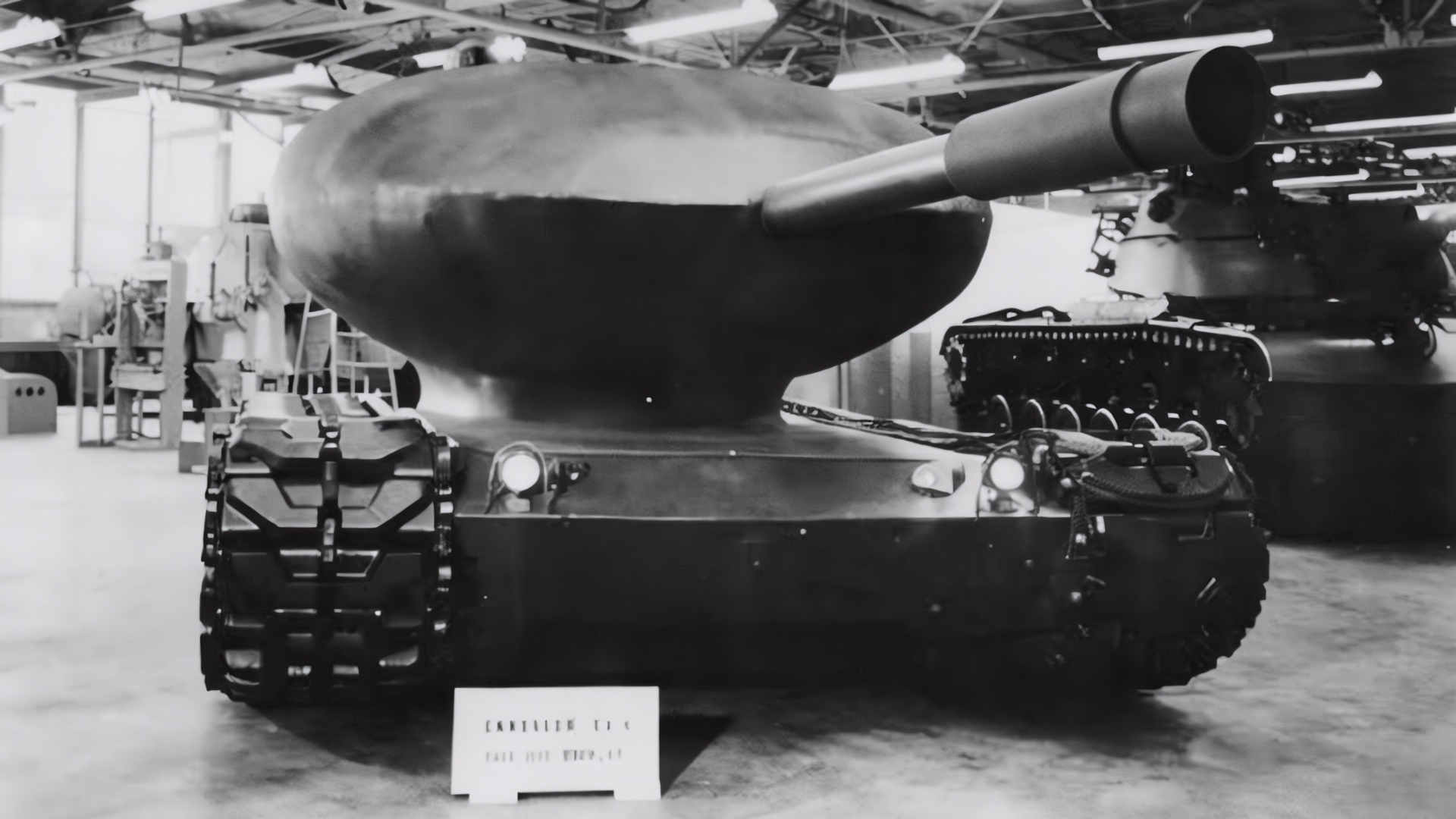
 TV-8 Tank Creative Commons Image
Summary and Key Points: After the Second World War, the Allies had won. The sweet taste of victory did not last long, however, as the United States quickly found itself in a tense standoff with the Communist Soviet Union. Both superpowers entered an arms race to field better, more advanced tanks than the other. In the 1950s, it appeared that the Soviets were winning. To gain an edge over the USSR, the U.S. explored several unconventional designs, many of which would never see the light of day. The TV-8 amphibious medium tank was one such idea. The TV-8 featured an incredibly outlandish design with an unusual-looking turret and a proposed nuclear-propulsion system. Unsurprisingly, the tank never entered production because it offered no advantages over more conventional designs.
Designing an Unconventional Medium Tank
The idea behind the TV-8 was first proposed during the Detroit Arsenal conference in 1955 as part of Operation Question Mark.
Operation Question Mark encouraged tank manufacturers to communicate and think outside the box to develop advanced, unconventional ideas.
The Detroit Arsenal conference sought to develop a new X-weapon that could serve as a medium tank while retaining amphibious capabilities.
The only requirement for the X-weapon was that it had to be available for mass production by 1961.
Under Project ASTRON, General Motors and Chrysler Corporation were awarded contracts to develop this new X-weapon.
Chrysler withdrew its contract, while General Motors and Continental Motors worked on various experimental concepts.
However, Chrysler returned to the project with a new tank concept dubbed TV-8.
Only a wooden mockup was ever built, but it was estimated to weigh roughly 25 tons and measure 2.9 meters tall and 8.9 meters long.
In keeping with the spirit of Operation Question Mark, the TV-8 featured a conventional and unique design.
Today, new tank designs are exploring an unmanned turret configuration, but the TV-8 took the opposite approach.
The tank’s hull was completely unmanned, with the entire crew housed inside the turret.
The crew included a driver, commander, gunner, and loader, but the tank could operate with only the driver and gunner thanks to new camera and computer technology.
Perhaps The Oddest-Looking Tank in History
The turret was rounded and egg-shaped to house the crew and powerplant while also providing buoyancy.
It consisted of two main components: the outer shell and the inner armor.
The outer shell encompassed the entire turret, except for the crew hatches, and was completely watertight, creating a large air pocket.
As a result, the 25-ton tank had enough displacement to float.
The back of the turret had a small water-jet pump, allowing it to cross rivers and lakes.
The inner turret sides were armored with 80mm of rolled homogeneous armor, while the front was 70mm but heavily angled.
The turret roof also housed two coaxial 0.30-caliber machine guns and a remote-controlled 0.50-caliber machine gun.
For its primary armament, the TV-8 carried a 90mm T208 smoothbore gun.
The gun was fitted to the turret floor, with hydraulic cylinders allowing it to elevate and depress.
The T208 was unique as it was intended to operate with a liquid propellant system.
The shell was loaded into the gun, after which liquid propellant was injected into the combustion chamber.
To fire the gun, the liquid propellant was ignited, and the resulting gases would propel the shell forward.
Liquid propellant interested the U.S. for a while because, in theory, it offered several advantages over the traditional case system.
On paper, liquid propellants offered higher muzzle velocities and eliminated the need for discarded casings.
Liquid propellants could also be easily isolated from the crew for better survivability.
In practice, however, liquid propellants were unreliable and filled the crew compartment with toxic gases after firing.
A Nuclear Powered Tank?
As unorthodox as the TV-8’s turret was, its most unusual feature was its propulsion.
In some iterations, the tank would use a conventional Chrysler V-8 300 horsepower engine to power two electric motors.
Other power sources were considered, including a vapor-cycle engine using hydrocarbon fuels and a more outlandish vapor-cycle engine powered by nuclear fuel.
The miniature nuclear reactor would produce steam, which would turn the turbine blades and generate electricity.
Based on the little information available on the tank, completely isolating the crew from the reactor’s gamma rays would have been impossible given their proximity.
Unsurprisingly, TV-8 was not selected for further development and was canceled in 1956.
The concept had too many downsides and was largely impractical.
Additionally, the nuclear reactor would have been too hazardous for the crew and would have required constant crew rotation to avoid long-term exposure to nuclear radiation.
Furthermore, aside from amphibious capabilities, the design offered no immediate advantage over conventional designs.
Overall, the TV-8 was designed to operate in extreme conditions in the event of a nuclear exchange with the Soviets. While it may have been impractical, it was at least an original idea.
About the Author: Isaac Seitz
Isaac Seitz, a Defense Columnist, graduated from Patrick Henry College’s Strategic Intelligence and National Security program. He has also studied Russian at Middlebury Language Schools and has worked as an intelligence Analyst in the private sector.