
Ukraine has struck Russian factory vital for Moscow’s missiles, private intelligence firm says

GLASGOW, Scotland — A Russian factory that Ukraine struck on Sept. 26 supplies electronics for a wide range of Russia’s missiles, potentially leaving Moscow without a fallback supplier, according to leaked documents obtained by the Ukrainian private intelligence firm Dallas Analytics.
The documents about the factory in question, Azov Optical-Mechanical Plant (AOMZ) in Russia’s western Rostov Oblast, cover April 2023 to March 2025 and include internal correspondence, state contract records and cooperation schedules. They also include letters from the Tactical Missiles Corporation (KTRV), the state holding company that owns the plant. Among the documents is an apparent supply schedule of more than 70 line items, naming 44 component suppliers.
The documents, Dallas Analytics said, place AOMZ in the production chains of “at least seven” missile programs, including the Kh-101 cruise missile, the R-37M air-to-air missile and the Oreshnik intermediate-range ballistic missile. An additional document provided to Defense News by Dallas Analytics lists a line item identified as components for an air-to-air missile with the additional comment “export China 192 pieces.”
Records put the value of components slated for production there in 2025 at 583.6 million rubles ($6.9 million), of which 497.6 million ($5.9 million) had been paid in advance.
Ukraine’s Security Service said it hit the plant, in the southwestern Russian city of Azov, overnight on Sept. 26 with Neptune cruise missiles and drones. Rostov Governor Yuri Slyusar acknowledged a drone attack on Azov that damaged “industrial facilities” and residential buildings. Russian officials have not named AOMZ as a target or confirmed damage to it. Ukrainian President Volodymyr Zelenskyy said a plant in the region making missile components was hit.
Dallas Analytics said AOMZ builds the Kh-101 cruise missile’s “Otblesk” navigation lidar and its flight automation block, and it claimed there is no alternative supplier for either. It noted that Russia has fired the Kh-101 en masse at Ukrainian cities and energy infrastructure.
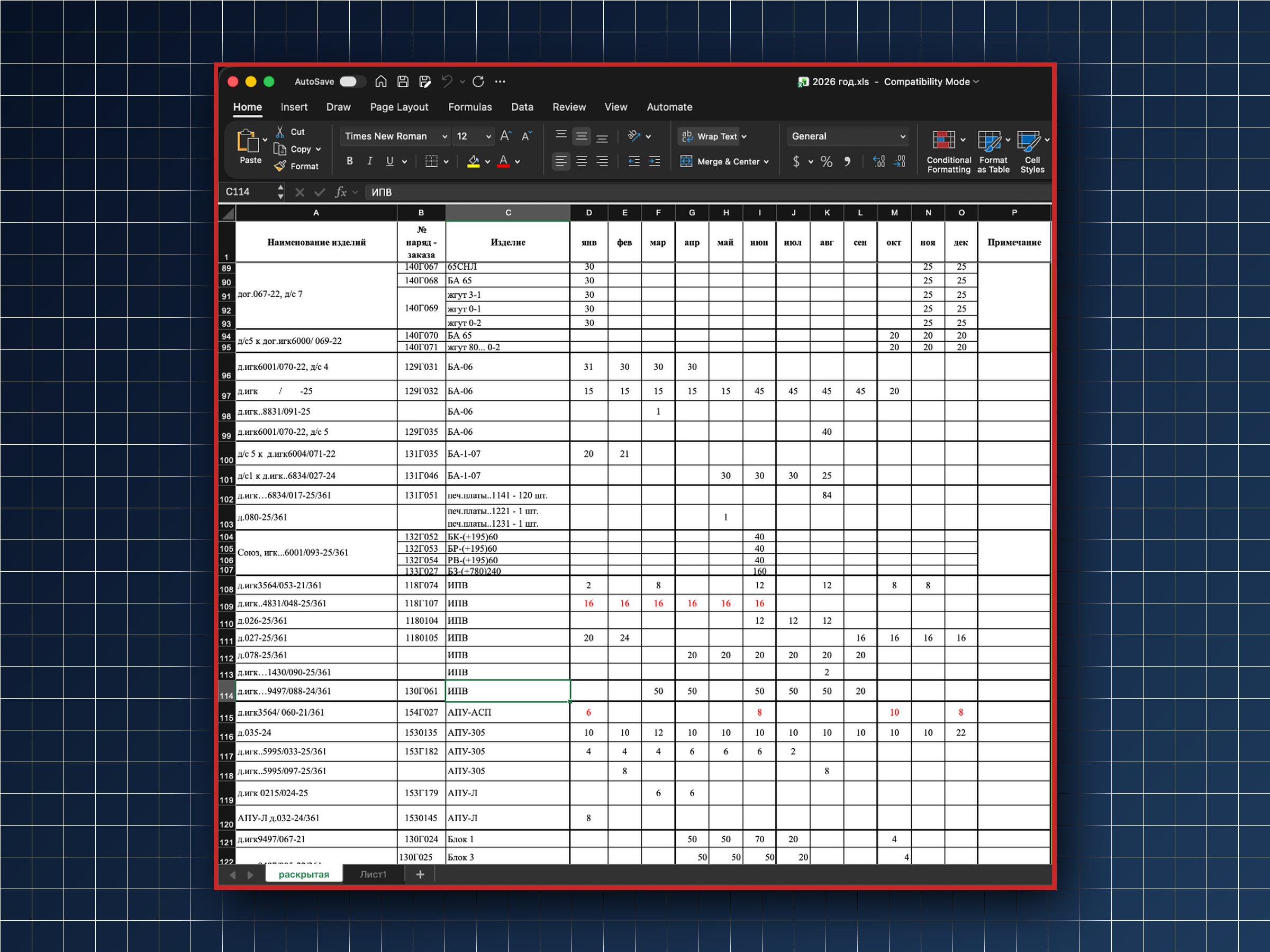
A set of additional documents reviewed by Defense News appears to show the plant’s production schedule for 2026, providing a glimpse of the components in the pipeline for the remainder of the year. Among them are 36 sets of electrical and power units destined for what Dallas Analytics identified as the R-37 air-to-air missile, as well as 41 units of item “65СНЛЭ,” meant for what the intelligence firm said is an export version of the Kh-38 air-to-surface missile. A further 50 such items were on the production docket for November and December, slated to power a domestic version of that weapon.
The firm also said the supply schedule lists TRV-Engineering, KTRV’s procurement arm, as a supplier of microcircuits for the Kh-101’s navigation set. A previous investigation identified TRV-Engineering as a channel for importing foreign microelectronics.
The Kh-101 has been used regularly to strike Ukraine. A variant with a nuclear warhead, called the Kh-102, also exists.
A KTRV letter dated Mar. 4, 2025, and marked “URGENT!!!” said the Russian Aerospace Forces wanted more deliveries from 2026, Dallas Analytics said. The document lists 500 each of several electronic blocks as well as 1,000 R-37M missile housings a year. AOMZ was given 72 hours to respond to the government on whether they could deliver the new quotas.
The United States government placed sanctions on the plant in April 2022. The European Union, Britain, Japan, Ukraine and other countries have followed suit.
Dallas Analytics pointed to the use of intermediaries and front companies for the procurement of components globally, allowing plants like AOMZ to operate despite international sanctions.
Ukraine struck the Azov Optical-Mechanical Plant in Rostov Oblast, Russia, on September 26, 2023, using Neptune cruise missiles and drones. This factory is vital for supplying electronics for several Russian missile programs, including the Kh-101 cruise missile. The attack potentially disrupts Russia's missile production capabilities, as the plant has no alternative suppliers for key components.
- Ukraine struck the Azov Optical-Mechanical Plant on September 26, 2023.
- The factory supplies electronics for various Russian missile programs.
- The attack was conducted using Neptune cruise missiles and drones.
- The plant is critical for the production of the Kh-101 cruise missile and other missile systems.
- The value of components scheduled for production in 2025 is approximately 583.6 million rubles.