
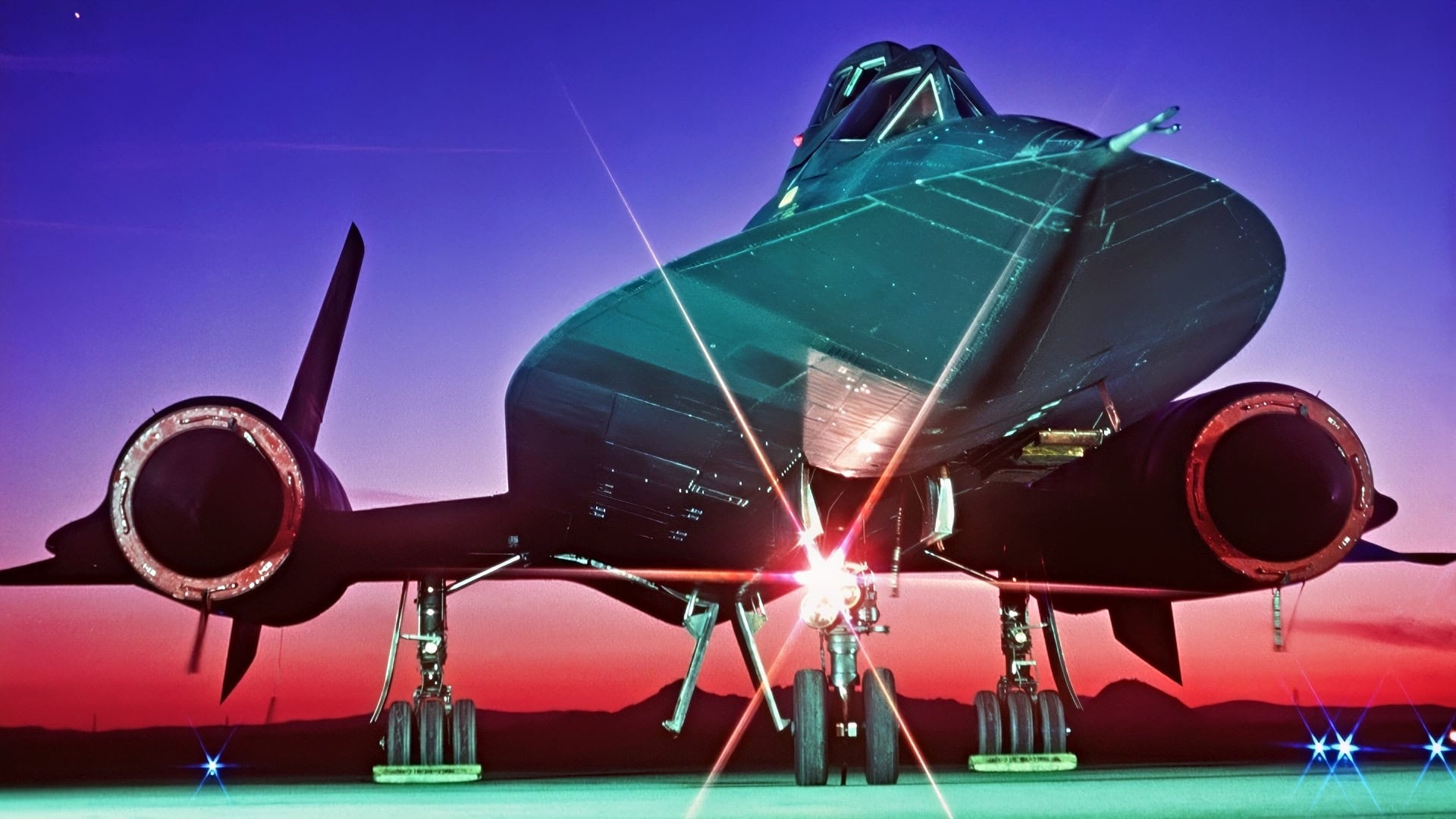
 SR-71 Blackbird at Night
One of the most storied, celebrated spy platforms of the Cold War may have a new lease on life — if NASA can locate willing and able retired personnel to get the plane airworthy once again. The aircraft in question is the SR-71A Blackbird, the once-enigmatic but now detailed-to-death spy plane that has been the subject of countless informational explainers online. But now, thanks to satellite imagery acquired by Aviation Week, an aerospace-focused magazine, it seems that the last SR-71A that could be returned to flight has left what was thought to be its final resting place at Lilly and Walker Avenues at the Armstrong Flight Research Center on Edwards Air Force Base in California.
That SR-71A, with Tail Number 844, had been on permanent display since 1999. But according to Mike Relja, a retired SR-71A test engineer for the U.S. Air Force and NASA, NASA wants to return that bird to the air.
But NASA seems to be playing coy with the details.
Mysterious Goals for SR-71 Comeback
One possible reason for returning the Blackbird to flight would be to support NASA’s X-plane research. NASA dubs X-planes as research planes used to advance flight research for other high-performance projects, including missiles, prototypes, and one-off technology demonstrators.
“We recognize the interest in the SR-71 and its remarkable history at NASA but have no additional information to share regarding the aircraft at this time,” a spokesperson told Aviation Week in response to queries about why the Blackbird had been removed from its display location.
A Momentous Task
Getting a retired aircraft back into the air would be a significant job, but for an aircraft as high-performing as a Blackbird, it will be an effort of herculean proportions. For starters, the aircraft in question is nearly six decades old.
And for another, it has been resting in place for almost 27 of those years. But following the Blackbird’s retirement, the supply, engineering, and support chains that serviced the United States’ fleet of SR-71sshuttered, presenting a two-pronged problem.
First, NASA needs to find engineers and support staff who are familiar with the SR-71, many of whom are retired and perhaps unwilling to leave retirement and rejoin the program. Second, if NASA can find enough knowledgeable individuals, their task would not be easy.
Parts of the SR-71A in question are thought to be flooded with sand and water, perhaps as a ballast substitute for the fuel that would normally fill the plane’s internal cavities.
And the jet’s two enormous engines have in all likelihood been ignored for the entirety of the plane’s time on display.
“When we were operational, if we had a spare engine, every 90 days we had to rotate the engine,” Relja said to Aviation Week, explaining the scope of the challenge. “Every 180 days, we had to run it to keep it as a ready spare. Now you’re talking about engines that have been sitting for 30-plus years.”
Further compounding the problem is the 2007 decision by NASA and the U.S. Air Force to dispose of spare SR-71 parts.
At the time, it seemed incredibly unlikely that Blackbirds would ever be recalled to service again, which at the time was not an illogical conclusion for the money-saving move.
How much it would cost to get an SR-71 airworthy again is speculative, but it is all but certain to cost a mint. Besides restoring the SR-71’s airframe integrity, the Blackbird’s bespoke fuel, as well as the triethylborane it needed to ignite it, would have to be sourced or distilled again.
Much of the related support equipment probably no longer exists either.
“To raise the wing, you need a cart,” Relja told Aviation Week. “To get the engine out, you need a cart. You need equipment to pull the [engine] spikes, pull the [ejection] seat. All that stuff is gone.”
One potential workaround could be cannibalizing SR-71 parts from decommissioned planes on static display at aviation museums across the United States. It wouldn’t be a perfect solution, but it could be enough to get the SR-71A back into the air.
A further question is how long NASA would like to fly the aircraft, and whether scrounged spare parts are enough to meet the number of flights NASA hopes to make with the Blackbird.
About the Author: Caleb Larson
Caleb Larson is an American multi-format journalist based in Berlin, Germany. His work covers the intersection of conflict and society, focusing on American foreign policy and European security. He has reported from Germany, Russia, and the United States. Most recently, he covered the war in Ukraine, reporting extensively on the shifting battle lines in the Donbas and writing about its civilian and humanitarian toll. Previously, he worked as a Defense Reporter for POLITICO Europe. You can follow his latest work on X.