
Ukraine's 155-mm Record Purchase Highlights Europe's Ammunition Problem 2026
 Dr. Klaus Weber
Ukraine's 155-mm Record Purchase Highlights Europe's Ammunition Problem 2026
On May 25, the Ukrainian Ministry of Defense reported the largest procurement operation in the history of the Defence Procurement Agency DOT: long-term 155-mm artillery ammunition, six winners in the competition, 16 percent savings compared to the initial amount, and delivery of the entire volume still in 2026. At first glance, this sounds like a success story from Kyiv. However, for Europe, it is primarily a test of its own armament policy. The crucial question is not whether Ukraine can buy cheaper. The question is whether the European ammunition market is even capable of meeting such Ukrainian tenders in the necessary quantity and speed.
The news comes just a few weeks after Ukrainian industry representatives publicly warned of delays in 155-mm contracts. At the end of April, Ukrainian Armor criticized that long-range ammunition planned for 2026 had not yet been contracted and that previous suppliers had only fulfilled 30 to 50 percent of their obligations. Therefore, the fact that DOT is now reporting a record contract is more than just an administrative advancement. It is an attempt to transform an improvised war economy into a capable procurement institution.
The Operational Core of the 155-mm Problem
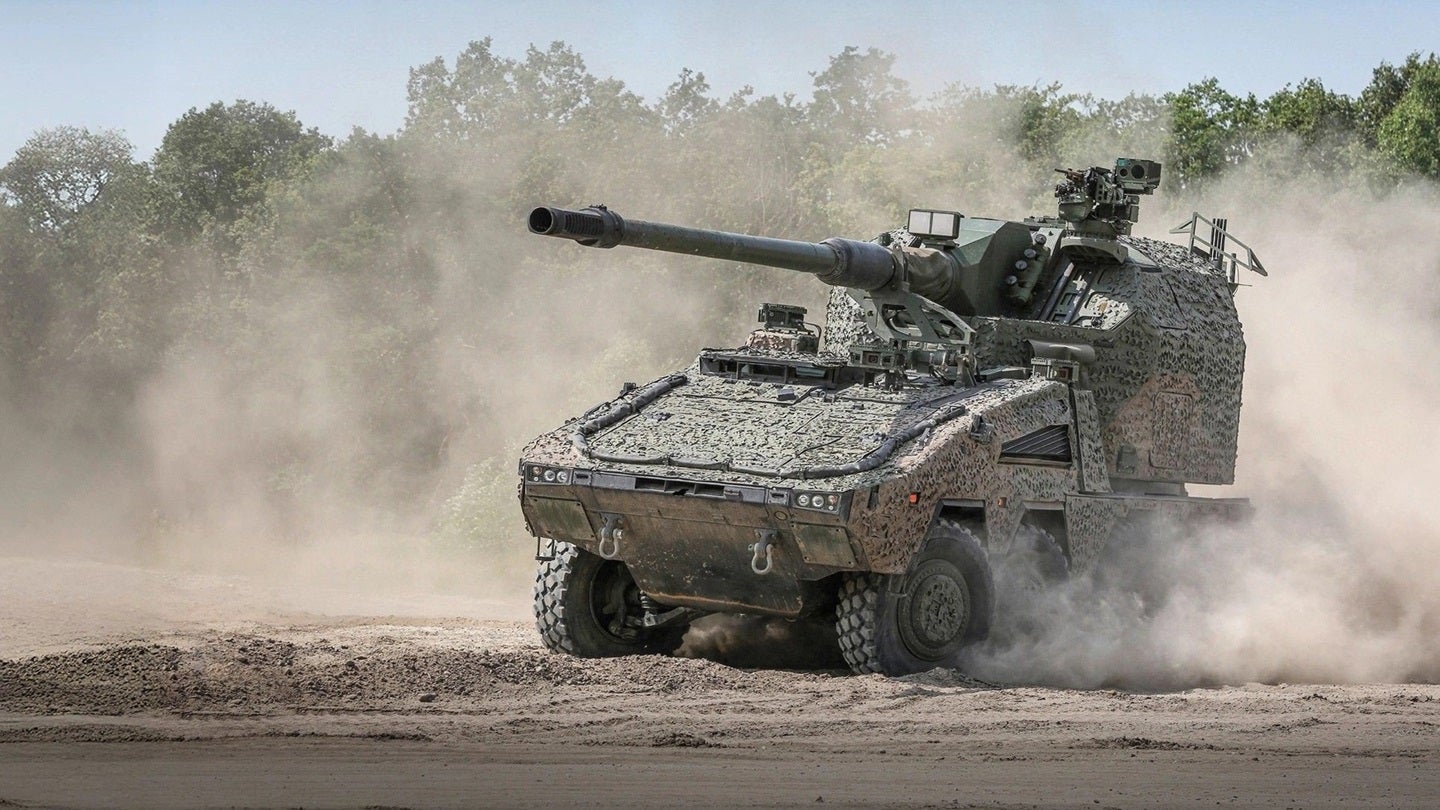
155-mm ammunition is not a spectacular wonder weapon. Precisely for this reason, it is strategically crucial. It connects Western howitzers like CAESAR, PzH 2000, Krab, M777, RCH 155, and Ukrainian Bohdana systems with daily fire control on a front where range, counter-battery time, and ammunition stock directly determine tactical mobility. Long-range variants are particularly valuable because they can threaten Russian artillery, logistics points, and command facilities beyond the reach of standard ammunition.
According to the Ukrainian Ministry of Defense, these long-range shells are among the most urgent front needs. Six suppliers were selected because they could demonstrate the most economically advantageous offers and the ability to deliver on time. This formulation is important. Kyiv is not just buying the cheapest product; it is trying to connect price, production capacity, and delivery risk. For a European procurement culture that has been focused on small series, national special requests, and slow framework contracts for decades, this is an uncomfortable lesson.
Why Competition Alone Does Not Create Capacity
The 16 percent savings are politically attractive. They show that transparent procedures in war procurement do not have to be automatically slower. But competition can only take place between real existing capacities. If six suppliers win, it does not mean that Europe has a robust ammunition base. It initially means that Kyiv finds multiple supply lines to procure a single bottleneck product.
Defense Express estimated the Ukrainian need for long-range 155-mm ammunition for 2026 at 1.2 million rounds. Rheinmetall could reportedly supply about 100,000 of those, or around eight percent. Even if this number does not describe the entire European market, it illustrates the structural problem: individual showcase companies are politically overinterpreted. A new plant, a large order, or a press conference does not replace a reliable supply chain for steel bodies, explosives, fuses, propellants, packaging, quality assurance, and transport.
The Norwegian-Ukrainian cooperation for long-range shells, presumably with NAMMO as the central industrial player, points in the same direction. NAMMO offers 155-mm HE-ER ammunition with a range of about 34 kilometers from 52-caliber barrels and up to 41 kilometers in base-bleed configuration; the ramjet-155 concept developed together with Boeing aims for significantly greater ranges but is not a serial solution for current needs. Europe's problem is therefore not a lack of technology. It is the discrepancy between technological options and industrial mass suitability.
The Institutional Point for Europe
Here lies the real European dimension of the DOT announcement. The EU has created numerous instruments with ASAP, SAFE, and the Ukraine Support Loan Architecture to facilitate ammunition production and joint procurement. However, instruments are not shells. A credit framework generates demand, a funding line reduces investment risks, and a political goal creates visibility. What they do not automatically produce are more trained specialists, more nitrocellulose, more quality assurance, and more certified series production.
Weberianly formulated: Europe still too often confuses financing capability with delivery capability. If Kyiv saves 16 percent with a competition, it is a good sign for Ukrainian procurement reform. However, if the same tender can only be covered by bundling scattered suppliers, it is a warning signal for Europe. Ukraine is building a procurement logic under war pressure that learns faster than many EU member states in peace budgets.
This is especially true for Germany. Berlin finances large packages, supports Patriot missiles, IRIS-T, drones, and artillery. At the same time, the German contribution is often hampered industrially by procedures, secrecy, and fragmented project logic. The turning point has mobilized money; however, it has not yet created a new ammunition management philosophy. A special fund can utilize factories if long-term purchase contracts and standardization follow. Without these elements, it will lead to a budgetary bridge between old structures.
Procurement as a Security Guarantee
For Ukraine, the contract means immediate firepower. For Europe, it is a governance test. Those who discuss security guarantees for Kyiv but cannot guarantee a reasonable ammunition base are discussing in the wrong order. Artillery ammunition is not the glamorous side of European security policy. But it is measurable, deliverable, or not deliverable. Precisely for this reason, it quickly exposes political rhetoric.
The next phase, which Fedorov announced for FPV, Middle-Strike, and Deep-Strike drones, will transfer the same pressure to other armament sectors. If DOT actually shifts to tender-based procedures more broadly starting this summer, a procurement model will emerge in Kyiv that forces European suppliers to be not only politically European but also competitively priced and production-wise. This is good for Ukraine. It is uncomfortable for those capitals that preach European sovereignty but mean national industrial policy.
The record purchase of 155-mm long-range shells is therefore not a marginal issue of Ukrainian artillery. It highlights the central tension of European defense policy in 2026: Ukraine is learning to competitively procure scarce armament goods under wartime conditions; Europe is still learning to produce such goods in strategic quantities. More money is necessary. But if it is not translated into standardized, long-term, and cross-border production capacity, it remains accounting with security vocabulary.
Sources
- Ukrainian Ministry of Defense, May 25, 2026, record procurement of 155-mm long-range ammunition.
- The New Voice of Ukraine, April 29, 2026, criticism of delays in artillery ammunition contracts.
- Defense Express, May 8, 2026, Ukrainian need of 1.2 million 155-mm long-range shells and Rheinmetall capacity.
- Defense Express, May 12, 2026, Ukrainian-Norwegian cooperation for the production of 155-mm long-range ammunition.
Ukraine's Defense Ministry announced a record procurement of 155-mm artillery ammunition on May 25, 2026, to address a critical shortage for the upcoming year. The need is estimated at 1.2 million rounds, with six suppliers selected for their economic and timely delivery capabilities. This procurement underscores the logistical challenges faced by Europe in meeting military supply demands amid ongoing conflict.
- Ukraine's Defense Ministry reported a record procurement of 155-mm ammunition on May 25, 2026.
- The procurement aims to address a critical shortage of long-range artillery ammunition.
- Ukraine's need for long-range 155-mm ammunition is estimated at 1.2 million rounds for 2026.
- Six suppliers were selected based on their ability to deliver economically and on time.
- The procurement highlights Europe's challenges in meeting military supply demands.