
Ukraine's 2026 Gripen Bet Pulls Sweden Deeper Into the War
 Alexandra Reeves
Ukraine's 2026 Gripen Bet Pulls Sweden Deeper Into the War
Sweden is no longer just a generous Nordic supplier in Ukraine's war. It is edging toward becoming the owner of a very specific problem: helping Ukraine turn the Saab JAS 39 Gripen from a political promise into a survivable combat aircraft under Russian missile fire.
That is the real meaning of Volodymyr Zelenskyy's visit to Sweden on 28 May. According to the Associated Press, Zelenskyy said Kyiv and Stockholm are preparing a major defence package and working on a deal to provide Gripen fighter jets to Ukraine. The Swedish government, in its own notice, said Prime Minister Ulf Kristersson and Zelenskyy would hold a joint press conference in Uppsala to make an announcement in the area of air defence. Swedish media, citing Aftonbladet, reported that the package was expected to involve Gripen C/D aircraft, with longer-term negotiations around the newer Gripen E.
There is a temptation to treat this as another fighter-jet headline. Ukraine has already absorbed F-16s, lobbied for Mirage aircraft, and built a wartime air force out of whatever its partners could politically and logistically release. But Gripen is different. It is not a prestige platform designed around immaculate main operating bases and huge support chains. It was built for a small country expecting to fight a larger Russian threat from dispersed roads, hidden strips and improvised servicing points.
That is why Kyiv has kept coming back to it.
Gripen Fits Ukraine's Worst Conditions
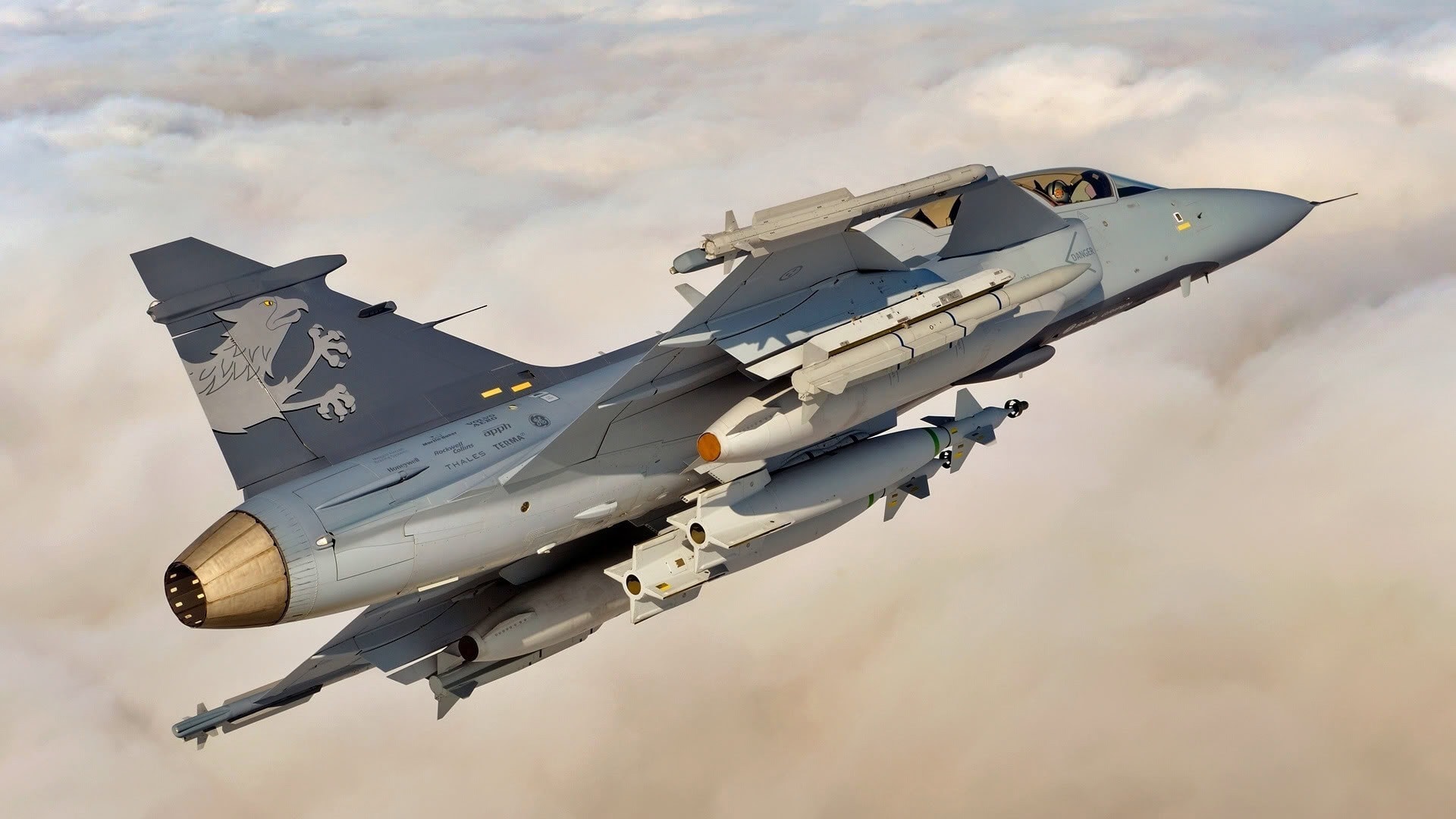
The Gripen C/D is not magic, and anyone selling it that way is doing Ukraine no favors. It is a fourth-generation multirole fighter whose value comes from fit, not from myth. Saab's public material for the Gripen C-series emphasizes short combat turnaround, road-base operations and a support model designed around limited ground crews. Its newer Gripen E line adds a GE F414G engine, AESA radar, IRST, advanced electronic warfare, ten hardpoints and compatibility with weapons including Meteor and IRIS-T, according to Saab.
Ukraine's immediate interest, however, appears to be practical. Swedish reporting points to older C/D aircraft as the near-term donation candidate. Those aircraft matter because they could arrive faster than a clean-sheet Gripen E fleet, while still offering Ukraine something it badly needs: another Western aircraft type able to operate closer to the front without being chained to a small number of vulnerable concrete runways.
This is not an academic advantage. Russia has spent the last year trying to make Ukrainian air operations expensive through missile raids, glide bombs, reconnaissance drones and strikes on airfield infrastructure. A fighter that can disperse, refuel and rearm quickly is not invulnerable. But it complicates Russian targeting. It forces Moscow to hunt a moving system rather than a fixed installation.
That is exactly the kind of annoyance Ukraine is good at turning into strategic friction.
The Aircraft Is Only Half the Package
The awkward part is that Gripen's best qualities do not transfer automatically. Ukraine would need trained pilots, maintainers, weapons stocks, secure data links, spare parts, shelters, ground equipment and a Swedish political commitment to keep the system alive after the cameras leave Uppsala. The Swedish government's military support page says Stockholm's aid to Ukraine had already reached roughly SEK 103 billion after the February 2026 package, with an SEK 80 billion military support framework for 2026-2027. That is serious money. It is also the beginning of a long obligation, not the end of one.
Sweden has been preparing the ground for this. Its earlier support packages included orientation training for Ukrainian pilots on JAS 39, airfield-support equipment, AMRAAM-related assistance and an official mandate to analyse possible Gripen support. Ukraine's Ministry of Defence said on 7 May that Mykhailo Fedorov discussed Gripen deliveries, anti-ballistic cooperation, radar systems, satellite communications and defence-industrial collaboration during talks in Stockholm and with Saab.
In other words, this is not a sudden romance. It is a slow procurement courtship conducted under wartime pressure.
The question is whether Sweden can carry the operational burden. Gripen was designed for Swedish defence logic: dispersed operations, national industrial control, and survival against a larger adversary in the Baltic-Nordic theatre. Exporting that logic to Ukraine means exporting more than aircraft. It means exporting doctrine, maintenance habits and a slice of Sweden's own wartime aviation brain.
Why Moscow Will Notice
Russia will almost certainly frame any Gripen transfer as escalation. That is predictable and not especially interesting. Moscow calls almost every new Western capability escalation until it becomes routine, then adapts its propaganda to the next one.
The more important issue is military adaptation. Gripen would give Ukraine another potential carrier for Western air-to-air and precision weapons, another platform for dispersed air defence, and another way to contest Russian aviation that has relied heavily on glide-bomb attacks from outside the reach of many Ukrainian short-range systems. If Gripen C/D arrives with compatible beyond-visual-range missiles and electronic warfare support, it could help pressure Russian aircraft operating near the edge of Ukrainian engagement zones.
It would not solve the ballistic-missile problem. Zelenskyy has been separately pressing Washington for Patriot systems and interceptors because Patriot remains Ukraine's core answer to Russian ballistic attacks. Gripen is not a substitute for Patriot. It is part of a different fight: preserving Ukrainian tactical aviation, complicating Russian air planning, and expanding the number of Western systems Moscow must account for every day.
The mainstream assumption in Washington has long been that Ukraine should keep its air force as simple as possible. There is logic there. Multiple aircraft types create maintenance headaches and training burdens. But that argument can become lazy. Ukraine's war is not being fought from a peacetime NATO airbase with standardized logistics and predictable sortie generation. It is being fought under attack, with aircraft hiding, moving, cannibalizing parts and surviving by being hard to pin down.
In that environment, a small fleet that can live rough may be worth more than a larger fleet that needs ideal conditions.
Sweden's War Role Is Changing
The strategic shift is not only Ukrainian. Sweden joined NATO as a new ally worried about Russia in the High North and the Baltic Sea. Now it is being pulled into a more direct role in Ukraine's air war. That brings benefits. A combat-proven Gripen ecosystem in Ukraine would give Saab and the Swedish armed forces priceless operational feedback. It would also anchor Sweden more firmly inside Europe's rearmament economy.
But there is a cost. If Gripen becomes a Ukrainian combat aircraft, Sweden becomes responsible for explaining why aircraft built for national defence are now central to another country's war effort. That is defensible. Russia started the war. Ukraine has every right to defend its airspace. Sweden has every reason to help. Still, the political temperature rises when a donor moves from ammunition, vehicles and sensors to fighter aircraft bearing a national industrial signature.
The short-term test is straightforward: whether Stockholm announces a real transferable package, not just another road map. The medium-term test is harder: whether Ukraine can integrate Gripen without starving its F-16 fleet of pilots, weapons and maintenance attention. The long-term test is brutal: whether European states can sustain advanced airpower support when American bandwidth is divided and Russian missile production keeps punishing Ukrainian cities.
If the Gripen deal moves from expectation to delivery, it will not win the air war by itself. It will do something more modest and more useful. It will make Ukraine's air force harder to kill, harder to predict and harder for Russia to exhaust. For a country fighting a larger enemy, that is not a side benefit. It is the point.
Sweden is preparing to provide Gripen fighter jets to Ukraine as part of a major defense package announced during Zelenskyy's visit on 28 May 2026. The package is expected to include Gripen C/D aircraft, with ongoing discussions about the newer Gripen E. This military support aims to enhance Ukraine's air defense capabilities against Russian threats.
- Ukraine is negotiating a defense package with Sweden for Gripen fighter jets.
- Zelenskyy visited Sweden on 28 May 2026 to discuss military support.
- The Swedish government has committed approximately SEK 103 billion in aid to Ukraine.
- Gripen C/D aircraft are expected to be the near-term donation candidate.
- Sweden's military support includes training for Ukrainian pilots and airfield-support equipment.