
U.S. Army awards contract for autonomous resupply drone
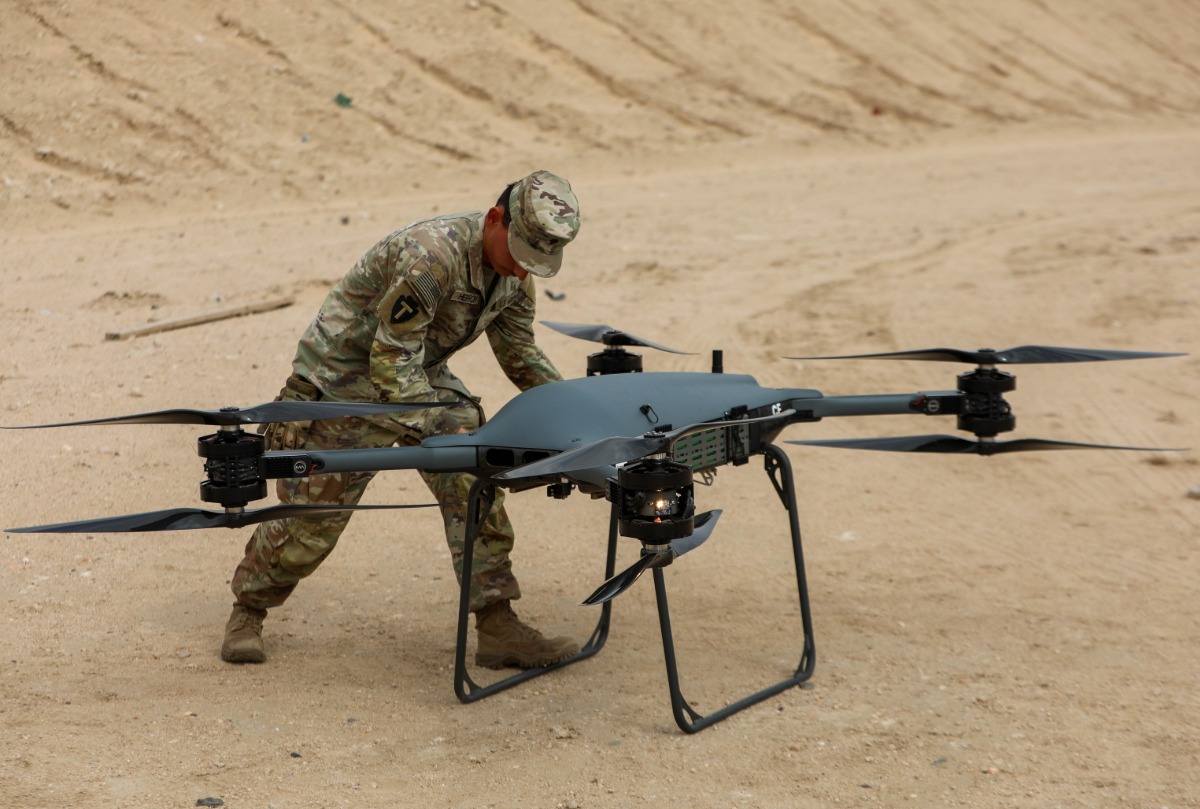
The U.S. Army has awarded a production contract to SURVICE Engineering for the Joint Autonomous Aerial Resupply System. A cargo drone designed to deliver supplies to troops in the field without putting additional soldiers at risk to do it.
The contract came through PM UAS, the Army’s Uncrewed Aircraft Systems Project Office sitting under the Capability Program Executive Aviation, using the Army’s UAS Marketplace Basic Ordering Agreement — a contracting vehicle specifically designed to compress the timeline between identifying a requirement and getting hardware into soldiers’ hands. “This sustainment capability offloads battlefield resupply missions from Soldiers to autonomous machines, speeding delivery of critical supplies to the point of need,” said Israel Marshall, product manager for Tactical UAS. “Reducing our timeline from requirement to fielding through the UAS Marketplace contracting strategy allows the Army to deliver capability at speed and scale,” Marshall said.
JTAARS is an autonomous aerial cargo delivery system built for exactly the kind of problem that has become increasingly dangerous on modern battlefields — getting supplies forward to dispersed, highly mobile forces without running trucks down roads that enemy drones and artillery can watch and strike. Ground-based supply lines have always been vulnerable, but the combination of persistent aerial surveillance and precision strike capability that characterizes current high-end conflict has made conventional resupply convoys a liability in ways that doctrine and vehicle armor can only partially address. An autonomous aerial system that can navigate to a forward position, deliver cargo, and return without a human crew aboard removes that vulnerability from the equation entirely — no driver, no escort, no soldiers exposed to the route.
According to the Army’s announcement, JTAARS enhances highly mobile tactical forces operating in dispersed and challenging environments by increasing the speed, endurance, range, and precision of sustainment operations. Those four qualities map directly onto the operational problems that commanders running dispersed formations face when they need ammunition, medical supplies, water, or batteries delivered to positions that may be kilometers from the nearest road and under observation by enemy ISR. A system that can fly a direct route at speed, regardless of terrain, and place cargo at a precise location gives those commanders a sustainment option that ground vehicles simply cannot replicate.
The UAS Marketplace BOA that funded this contract is itself worth understanding as a procurement mechanism. Standard defense acquisition for systems of this type can take years from requirement to fielding — design competitions, testing phases, low-rate initial production, operational testing, full-rate production decisions. The UAS Marketplace was built to bypass that timeline for drone capabilities, allowing the Army to award production contracts through a pre-qualified vendor pool with dramatically reduced lead times. The result is that JTAARS moves from contract award to soldiers’ hands on a schedule that would have been impossible under conventional acquisition, which matters when the capability being fielded is responding to a threat that is already present and evolving rather than a hypothetical future contingency.
The first is the Department of War’s Drone Dominance initiative, a top-level push to accelerate drone capability development and fielding across the services. The second is the Army’s own Transformation in Contact 2.0, which focuses specifically on getting emerging technologies validated and deployed to soldiers faster by testing them in operational units rather than waiting for laboratory evaluations to conclude before field exposure begins. JTAARS fits both frameworks — it’s a drone capability that goes directly to soldiers for operational experimentation rather than sitting in a testing pipeline, and the fielding approach is designed to generate feedback that informs how the system is used rather than assuming the requirement is fully understood before soldiers touch it.
The Multi-Domain Operations framework that the Army cites as the operational context for JTAARS deployment reflects where American ground combat doctrine has been heading for several years. MDO describes a fight in which land, air, sea, space, and cyber capabilities are integrated across echelons to create and exploit windows of advantage against a peer adversary — a fundamentally different model from the counterinsurgency and stability operations that consumed the Army’s attention for two decades after 2001. Sustainment in an MDO environment cannot rely on the same supply chain assumptions that worked in Iraq and Afghanistan, where the U.S. controlled the air and could generally predict which routes were safe. Autonomous aerial resupply addresses that gap without adding the risk signature that manned vehicles create.
SURVICE Engineering, the contract awardee, works with leading-edge companies around the world to develop and deliver what the company describes on its website as “innovative, disruptive new technologies.” Its drone work is built around the Tactical Resupply Vehicle family, developed in collaboration with UK-based Malloy Aeronautics — a field-proven cargo drone platform designed for tactically significant payloads and ranges. That partnership with a British UAS developer brings transatlantic experience in autonomous logistics directly into the Army’s JTAARS program, and the TRV’s existing operational track record gives the Army a system with real-world performance data rather than a clean-sheet design still working through its unknowns.
Autonomous cargo delivery won’t replace every ground resupply mission, and no one in the Army is claiming it will. But for the forward-most positions — the ones farthest from the wire, the ones that ground vehicles can’t reach without taking unacceptable risk — a system that flies autonomously, delivers precisely, and asks nothing of the soldiers waiting for it represents a genuinely different kind of capability.
Content preview only. Full article available at source. View Full Article
The U.S. Army awarded a contract to SURVICE Engineering for the Joint Autonomous Aerial Resupply System (JTAARS), an autonomous cargo drone designed to deliver supplies to troops without exposing soldiers to risk. This initiative aims to enhance logistics for highly mobile forces in challenging environments, addressing vulnerabilities in traditional ground supply lines. The contract was facilitated through the UAS Marketplace, allowing for expedited procurement of drone capabilities.
- The U.S. Army awarded a contract to SURVICE Engineering for the JTAARS.
- The drone is designed to deliver supplies autonomously to troops in the field.
- The UAS Marketplace BOA allows for faster procurement of drone capabilities.
- JTAARS enhances sustainment operations for highly mobile tactical forces.
- The system addresses vulnerabilities of ground-based supply lines in modern warfare.