
U.S. Army flies HIMARS 2,000 miles to fire live rockets at Kwajalein
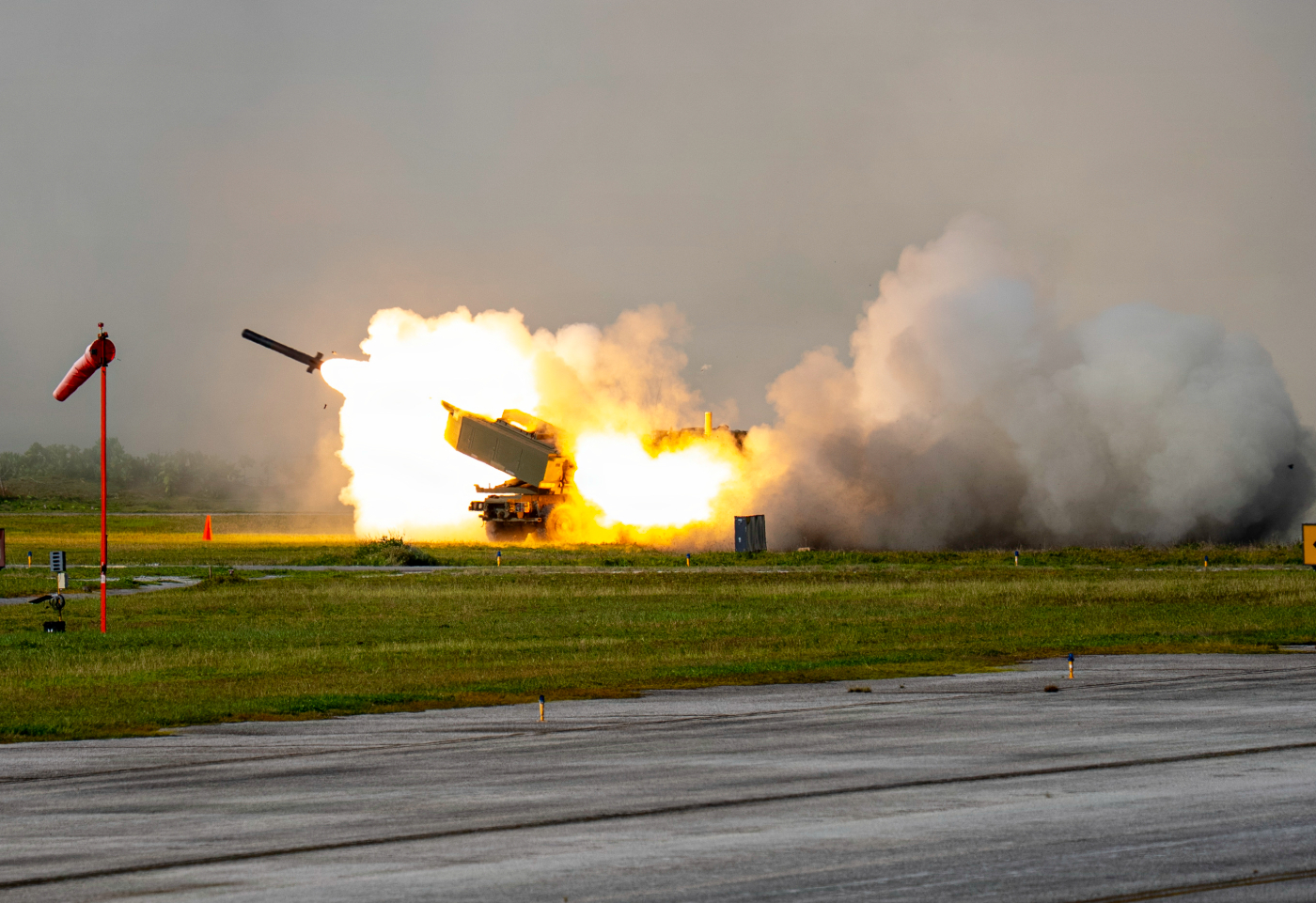
U.S. Army rocket launchers from Hawaii fired live rockets at Kwajalein Atoll in the Marshall Islands on Nov. 13, after U.S. Air Force C-17s flew them in for a strike-and-leave drill, the 25th Infantry Division said in a release.
The High Mobility Artillery Rocket Systems, or HIMARS, belong to the 2nd Battalion, 11th Field Artillery Regiment. They were hauled by C-17s from the Air Force’s 15th Wing at Joint Base Pearl Harbor-Hickam. The division called the event a HIMARS Rapid Infiltration, or HIRAIN, part of Joint Pacific Multinational Readiness Center Rotation 27-01.
The release didn’t say how many launchers flew to Kwajalein, what kind of rockets they fired, or how far the targets were. It also didn’t say whether the launchers flew straight from Hawaii. Kwajalein sits more than 2,000 miles (3,200 km) southwest of Honolulu, according to the Army.
“By executing these missions, we are rehearsing our ability to rapidly project long-range fires into the most austere environments in the region,” said Col. Bryan Fanning, commander of the 25th Division Artillery.
In a HIRAIN, the launcher rolls off a cargo plane, fires, then gets loaded back on and flown out. The idea, per the division, is to strike “without presenting a static target for adversary counterfire.”
Days earlier, on Nov. 10, the same unit ran a dry-fire version on Kauai, with no rockets launched.
“Whenever we prepare for these missions, we’re focused on speed and keeping up the communications,” said 1st Lt. Cameron Richardson, a platoon leader with Bravo Battery. Runways in the islands are usually very limited, he added, so the crews keep refining their footprint.
Richardson said the work depends on Army crews and Air Force loadmasters talking constantly, so the launchers are loaded, tied down and ready to fire as soon as the plane lands.
At Kwajalein, U.S. drones kept watch overhead while the battalion “engaged targets deep in the maritime domain,” the release said. Commanders used encrypted networks and what the division called “Super-Intelligence (SI) decision aids” to process sensor data and confirm targets before firing. After the mission, the launchers were secured for follow-on moves.
“This capability ensures we can rapidly project lethal fires to deter and defeat threats deep within the maritime domain,” said Maj. Andrea Swett, the 25th Division Artillery’s operations officer.
The division received 16 HIMARS in 2025. Earlier in the same rotation, 11th Airborne Division paratroopers flew nearly 3,000 miles from Alaska to jump into a training assault in Hawaii.
The division said the long-range drills prepare its soldiers for “scheduled spring and summer forward deployments to the Philippines” under Operation Pathways.
Content preview only. Full article available at source. View Full Article
U.S. Army rocket launchers from the 2nd Battalion, 11th Field Artillery Regiment fired live rockets at Kwajalein Atoll on November 13 during a strike-and-leave drill. The HIMARS were transported by C-17 aircraft from Hawaii as part of a HIMARS Rapid Infiltration exercise. U.S. drones provided aerial surveillance during the operation, which aimed to project long-range fire capabilities in austere environments.
- U.S. Army launched live rockets at Kwajalein Atoll on November 13.
- The operation involved HIMARS and was part of a strike-and-leave drill.
- C-17 aircraft transported the HIMARS from Hawaii.
- The event was termed a HIMARS Rapid Infiltration (HIRAIN).
- U.S. drones monitored the operation from above.