
U.S. Marines buy combat-tested anti-drone vehicles for $19 million
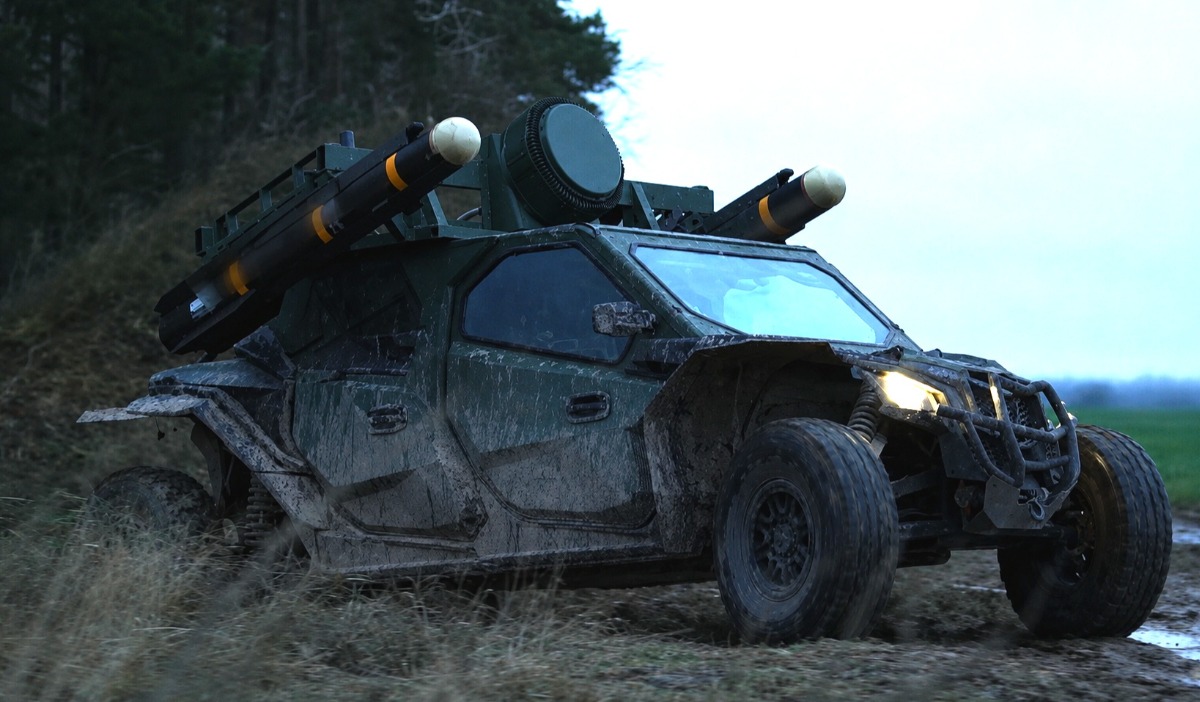
The U.S. Marine Corps has signed off on ten more drone-killing dune buggies for its troops, and the company building them is the same one whose vehicles have already been shooting down Russian-made attack drones over Ukraine.
A Pentagon contract announcement dated August 11 confirms that Vertex Modernization and Sustainment, a company based in Indianapolis, Indiana, and operating as part of the defense contractor V2X, will deliver 10 Tempest vehicles to the Marine Corps under a deal worth roughly $19 million, along with the software, spare parts, training, and other support services needed to keep them running in the field.
The Tempest is a lightweight, four-wheel-drive combat vehicle built from commercially available components rather than custom military hardware, a design choice that keeps costs down and makes repairs easier since parts can often be sourced from civilian suppliers rather than specialized defense manufacturers. Reports on the vehicle’s origins indicate it was built on a modified Can-Am Maverick X3, a rugged off-road buggy sold commercially for recreational use, then outfitted with dual missile launchers and a sensor suite designed to detect, track, and shoot down drones before they can strike Marines on the ground. V2X unveiled the Tempest publicly for the first time at the Association of the United States Army’s annual conference in October 2025, pitching it as an affordable, easily maintained answer to the wave of small attack drones that have become one of the defining threats on modern battlefields.
What makes the Tempest dangerous to drones is the same missile that has spent years destroying tanks and other armored vehicles. The vehicle carries AGM-114L Longbow Hellfire missiles, a radar-guided version of the Hellfire family originally developed for Apache attack helicopters, mounted on launchers that let the Tempest engage what the military classifies as Class 2 and Class 3 unmanned aircraft systems, roughly meaning drones ranging from small tactical reconnaissance aircraft up to systems approaching the size of a small manned aircraft. That places the Tempest squarely against the kind of loitering munitions and attack drones, including Iranian-designed Shahed drones that Russia has mass-produced and launched by the hundreds into Ukrainian cities, that have forced militaries worldwide to rethink how they protect troops and equipment from threats that used to be the exclusive concern of specialized air defense units.
At least two Tempest vehicles are already operating in Ukraine, where the Ukrainian Air Force has credited the system with destroying 21 Shahed drones since entering service, giving the Marine Corps a rare case of buying a weapon system with an active combat record rather than one that exists only in testing. That track record matters for a service branch weighing how quickly it can field new counter-drone capability against an evolving threat, since a system already proving itself under fire carries less risk than one still working through the Pentagon’s traditional testing and evaluation process.
The contract itself blends three different payment structures, a combination the Pentagon calls a hybrid contract. Part of the deal is firm-fixed-price, meaning Vertex gets paid a set amount regardless of its actual costs, part is cost-plus-fixed-fee, meaning the government reimburses Vertex’s costs plus an agreed profit margin, and part falls under a cost contract structure covering expenses without a separate fee attached. The agreement also operates as an indefinite-delivery/indefinite-quantity contract, a Pentagon procurement tool that sets up a framework for future orders without locking in exact quantities or total spending upfront, meaning the $19 million figure represents a starting point rather than a hard ceiling on what the Marine Corps might eventually spend on Tempest vehicles and support.
Work under the contract is expected to run through August 10, 2027, based out of Vertex’s Indianapolis facility.
Content preview only. Full article available at source. View Full Article
The U.S. Marine Corps signed a $19 million contract for ten Tempest anti-drone vehicles from Vertex Modernization and Sustainment on August 11, 2023. These vehicles, already operational in Ukraine, are equipped with AGM-114L Longbow Hellfire missiles and have successfully destroyed multiple drones. The contract includes comprehensive support services and is expected to run through August 10, 2027.
- U.S. Marine Corps signed a contract for 10 Tempest vehicles worth $19 million.
- The Tempest is designed to counter drones using AGM-114L Longbow Hellfire missiles.
- At least two Tempest vehicles are already operational in Ukraine, credited with destroying 21 Shahed drones.
- The contract includes software, spare parts, training, and support services.
- The contract is a hybrid structure, allowing for future orders without locking in exact quantities.