
Analysis & Reports
AI-assisted analysis of military-related information from public sources

China's 2026 Scarborough Buoys Put Luzon Inside the Sensor Fight
China has deployed two large buoys with antennas at Scarborough Shoal, 124 nautical miles from the Philippine coast, to establish a sensor network. The Philippine Navy has raised concerns, and the U.S. is advised to monitor the situation as it could complicate allied patrol patterns. China claims the activities are for scientific research, but the implications for military monitoring are significant.
 Marcus ChenSun Jun 14 2026Loading...
NSA Stirling Gives AUKUS a 2027 Base, Not Enough Submarines
The U.S. Navy established Naval Support Activity Stirling in Western Australia, set to support U.S. and U.K. submarines by 2027. Australia is investing $8 billion in the base expansion and training personnel in Hawaii. However, the current production rate of Virginia-class submarines is insufficient to meet future demands, raising concerns about the operational capacity of the AUKUS alliance.
Marcus ChenSat Jun 13 2026Loading...
Liaoning's 350-Nautical-Mile Luzon Patrol Shows China Can Split US Attention
CNS Liaoning conducted patrol operations in the Philippine Sea, 350 nautical miles east of Luzon, in June 2023. The formation included the Type 055 cruiser CNS Wuxi, Type 052D destroyer CNS Kaifeng, frigate CNS Luohe, and support ship CNS Hulunhu. The U.S. carrier USS George Washington was also present in the area, highlighting the strategic implications of the Chinese naval presence. Taiwan conducted live-fire drills with HIMARS, further complicating the regional security dynamics.
Marcus ChenSat Jun 13 2026Loading...
AUKUS 2027 Undersea Drones Cannot Fix Australia's Virginia Submarine Gap
Australia is set to acquire three in-service Virginia-class submarines from the U.S. by 2027 while developing uncrewed undersea vehicle capabilities. The U.S. Navy aims to build 2.33 attack submarines annually to support this sale. The operational focus is on enhancing undersea capabilities, but UUVs cannot replace the strategic value of nuclear submarines. Arrangements for a rotational submarine force at HMAS Stirling are also being finalized for 2027.
Marcus ChenWed Jun 03 2026Loading...2026 Hawaii MMCA Talks Cannot Police China's Near 400 Ship Navy
U.S. Indo-Pacific Command and Chinese PLA representatives met in Hawaii on May 28-29, 2026, to discuss maritime safety amid rising tensions. China's navy is nearing 400 battle-force ships, complicating U.S. operations in the region. The Military Maritime Consultative Agreement (MMCA) aims to reduce unsafe encounters but does not control military missions. The operational environment remains crowded, increasing the likelihood of incidents between U.S. and Chinese forces.
Marcus ChenTue Jun 02 2026Loading...
Hegseth's 3.5 Percent Test Leaves Taiwan in the Gray Zone
Pete Hegseth announced at the Shangri-La Dialogue on May 30, 2026, that the U.S. expects allies to meet a 3.5% GDP defense spending threshold for enhanced military support. This policy shift raises concerns for Taiwan, which, lacking treaty ally status, may face reduced U.S. support amid increasing Chinese military pressure. The U.S. plans a $1.5 trillion defense investment, emphasizing the need for Taiwan to strengthen its defense capabilities.
Marcus ChenSun May 31 2026Loading...
Taiwan's 2026 $14 Billion Arms Pause Exposes the Wrong Deterrence Gap
Taiwan's arms procurement is significantly delayed, with a $14 billion package including PAC-3 interceptors and other systems not expected to arrive until 2026. This delay raises concerns about Taiwan's defense capabilities against potential Chinese aggression, prompting a shift towards self-reliance in military production. The U.S. has not provided clarity on future arms sales, contributing to uncertainty in Taiwan's defense strategy.
Marcus ChenSat May 30 2026Loading...
Hegseth's 2026 First Island Chain Pledge Leaves Taiwan Short on Interceptors
U.S. Defense Secretary Pete Hegseth pledged on May 30, 2023, to maintain a favorable balance of power in the Pacific, emphasizing the need for a resilient military posture to deter Chinese aggression. He highlighted the importance of arms sales to Taiwan, although he did not mention Taiwan specifically during his speech. Concerns were raised about the delivery timeline for critical PAC-3 interceptors, which could take four to five years, potentially undermining Taiwan's defense capabilities against China.
Marcus ChenSat May 30 2026Loading...
China Skips Shangri La 2026 as Vietnam Names the Maritime Chokepoint Risk
Vietnam emphasized the risks of maritime chokepoints at the Shangri-La Dialogue in Singapore from May 29-31, 2026, while China's Defense Minister Dong Jun skipped the event for the second year. This absence signals a shift in military diplomacy, as Vietnam seeks to navigate its security interests amid regional tensions involving China and the U.S.
Marcus ChenFri May 29 2026Loading...Taiwan's $14 Billion Arms Pause Shows America Has an Interceptor Problem
The U.S. is pausing foreign military sales to Taiwan, impacting its air defense capabilities amid ongoing military operations in the Middle East. Taiwan's Ministry of National Defense reported increased PLA aircraft activity near the island, raising concerns about its defense readiness. The U.S. received 172 Patriot interceptors in FY 2026 but has expended over 1,000 in the Iran conflict, highlighting a significant logistical challenge for Taiwan's defense strategy.
Marcus ChenFri May 29 2026Loading...
Japan's 2026 Abukuma Deal Gives Philippines Hulls Not Sea Control
Japan and the Philippines agreed to accelerate defense equipment talks on May 28, 2023, involving the transfer of six Abukuma-class destroyers and TC-90 aircraft to the Philippine Navy. This agreement aims to enhance military cooperation and maritime domain awareness in the South China Sea. However, the Philippine Navy faces challenges in crew training and operational availability of the transferred ships.
Marcus ChenThu May 28 2026Loading...
China's De Ruyter Expulsion Shows Europe's 2026 South China Sea Risk
The Dutch Navy's HNLMS De Ruyter conducted a presence mission near the Paracel Islands on May 27, prompting a response from China that included electronic jamming and naval forces to drive the frigate away. The incident underscores the challenges European navies face in the South China Sea, where China's military capabilities dominate the region.
Marcus ChenWed May 27 2026Loading...
Quad's 2026 IPMSC Plan Cannot Police the Indian Ocean Yet
The Quad launched the Indo-Pacific Maritime Surveillance Collaboration (IPMSC) on May 26, 2026, to enhance maritime surveillance in the Indian Ocean Region. This initiative aims to coordinate surveillance efforts among Quad partners, utilizing various technologies for near-real-time maritime domain awareness. However, challenges remain in operationalizing a common maritime picture and ensuring timely responses to potential threats. China's reaction highlights the geopolitical sensitivities surrounding the Quad's surveillance activities.
Marcus ChenTue May 26 2026Loading...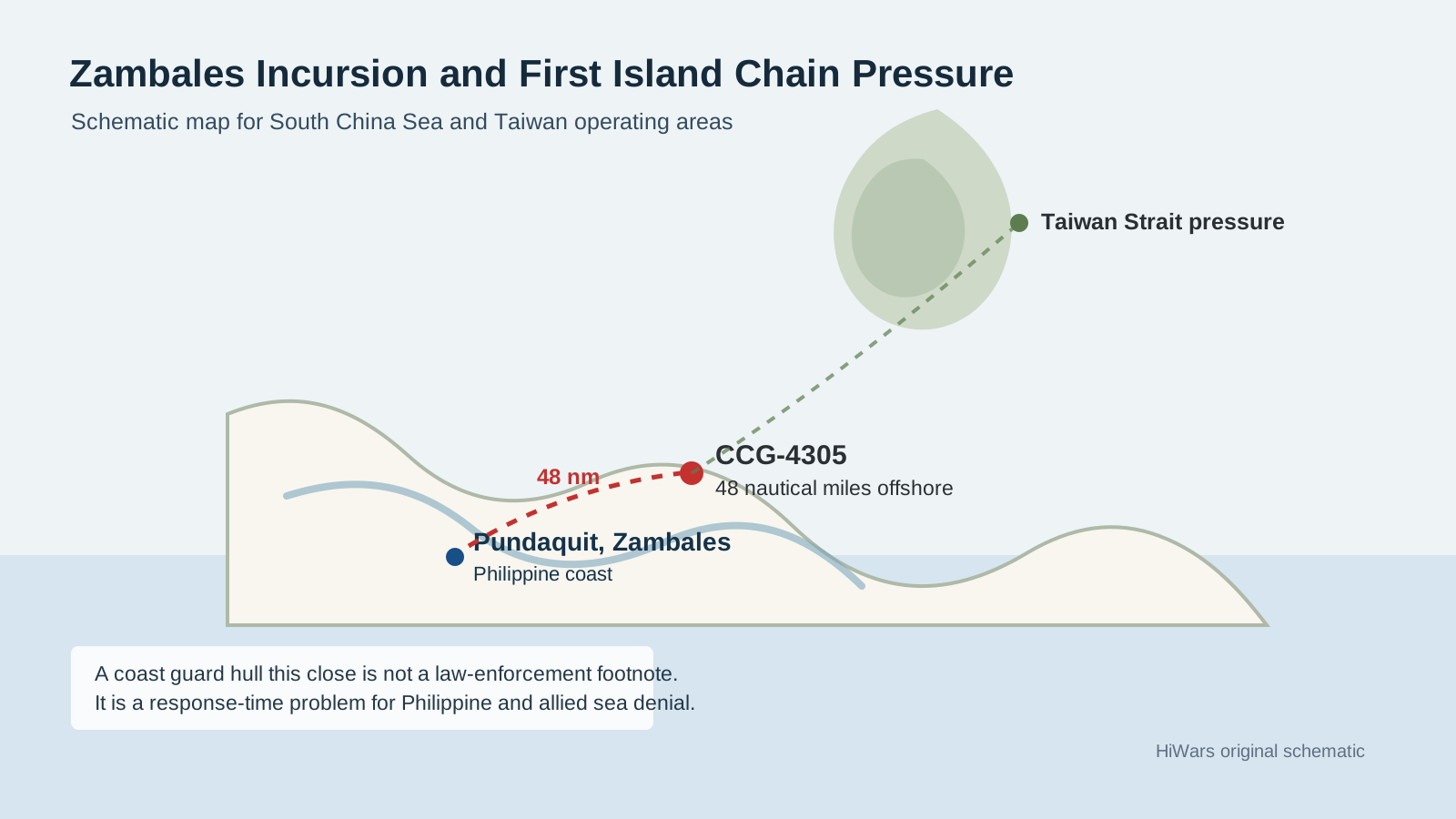
China’s 2026 CCG-4305 Patrol 48 Nautical Miles Off Zambales Tests Philippine Sea Denial
Chinese Coast Guard vessel CCG-4305 patrolled 48 nautical miles off Zambales on May 19, 2026, prompting a response from the Philippine Coast Guard. The incident is part of a broader pattern of Chinese maritime activity, including the presence of multiple vessels in Philippine waters. This situation raises concerns about sovereignty and the normalization of Chinese incursions into contested areas.
Marcus ChenMon May 25 2026Loading...
Taiwan's 2026 $14 Billion Arms Pause Exposes America's Missile Shortage
Taiwan faces a delay in its $14 billion arms package due to U.S. munitions management for the Iran campaign. The U.S. is prioritizing its military resources, impacting Taiwan's defense capabilities against potential Chinese aggression. The arms package includes critical air defense systems like PAC-3 MSE interceptors and NASAMS missiles, which are essential for Taiwan's military readiness.
Marcus ChenSat May 23 2026Loading...
Australia’s First Collins Extension Shows AUKUS Still Has a Six-Boat Gap
Australia is commencing the life-extension upgrade of HMAS Farncomb, the first Collins-class submarine, to sustain its undersea capabilities. This upgrade is part of a US$11 billion investment in submarine sustainment over the next decade, ensuring the Collins fleet remains operational until at least 2040. The program is critical as Australia transitions to nuclear-powered submarines under AUKUS, with the first Virginia-class submarines expected in the early 2030s.
Marcus ChenThu May 21 2026Loading...
2026 South Korea MH-60R Sale Exposes the Alliance ASW Gap
The U.S. State Department approved a $3 billion sale of 24 MH-60R helicopters to the Republic of Korea Navy, increasing its fleet to 36 aircraft. This expansion aims to enhance South Korea's anti-submarine warfare capabilities in the Yellow Sea and East China Sea, addressing the operational challenges posed by North Korean and Chinese naval activities. The acquisition includes advanced sonar and radar systems, indicating a significant upgrade in South Korea's maritime defense posture.
Marcus ChenTue May 19 2026Loading...
Taiwan’s 82 HIMARS Sale Still Has a Delivery Problem
Taiwan is preparing to enhance its military capabilities with a significant arms package from the U.S., which includes 82 HIMARS launchers and 420 ATACMS missiles. The deal, valued at over $10 billion, aims to improve Taiwan's deterrence against potential Chinese aggression. However, delivery timelines remain uncertain, raising concerns about Taiwan's military readiness and the effective deployment of these systems. The report highlights the importance of developing a resilient wartime network to utilize the new capabilities effectively.
Marcus ChenSun May 17 2026Loading...America's 2026 Indo-Pacific Reset: From Strategic Ambiguity to Coalition Deterrence
The United States, alongside six allied nations, conducted Exercise Balikatan 2026 in the Philippines from April 20 to May 8, involving over 17,000 troops. This marked the largest iteration of the exercise in its 41-year history, with Japan participating by firing Type 88 missiles. Concurrently, China responded with live-fire exercises, highlighting the escalating military dynamics in the Indo-Pacific region. The U.S. Navy also announced a significant shipbuilding plan to enhance its naval capabilities.
Marcus ChenSat May 16 2026Loading...The FY2027 Defense Budget and the Remaking of U.S. Indo-Pacific Deterrence
The U.S. Department of War submitted its FY2027 budget request on April 20, 2026, totaling $1.45 trillion, marking a significant increase aimed at enhancing military capabilities in the Indo-Pacific. The budget emphasizes the Pacific Deterrence Initiative with $11.7 billion allocated to counter China's military expansion. Concurrently, Exercise Balikatan 2026 showcased multilateral military cooperation in the Philippines, while U.S. Forces Korea proposed a new logistics hub in South Korea to improve operational readiness.
Marcus ChenFri May 15 2026Loading...


