
Air Force MQ-9 downs aerial targets with cheap air-to-air missiles
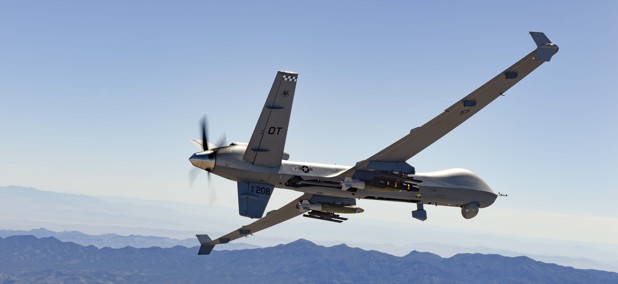
An Air Force MQ-9 drone has downed aerial targets with a relatively inexpensive air-to-air missile, part of the Pentagon’s quest for more cost-effective defense against drones.
MQ-9 maker General Atomics announced on Monday that the Air Force had used a Reaper armed with laser-guided Advanced Precision Kill Weapon System, or APKWS, missile in a demonstration at the Nevada Test and Training Range.
“We recognize the value that a system like APKWS brings to the MQ-9 aircraft as a tool to counter one-way attack drones,” General Atomics President David Alexander said in a press release. “APKWS can increase the number of weapons the MQ-9A is able to carry, as well [as] being able to carry new lower cost weapons.”
Since Operation Epic Fury began in February, Iran’s $30,000 Shaheds have damaged overseas bases, destroyed U.S. aircraft, and killed American troops. The U.S. military has used fighter jets armed with million-dollar missiles to down the one-way attack drones. An APKWS costs $25,000 to $40,000, according to think tank analysts.
The $30 million MQ-9 is often used for intelligence missions but can be armed with AGM-114 Hellfire missiles, GBU-12 Paveway IIs, GBU-38 Joint Direct Attack Munitions, GBU-49 Enhanced Paveway IIs or GBU-54 Laser Joint Direct Attack Munitions, according to a service fact sheet.
A General Atomics spokesperson referred questions to the Air Force, and the service did not immediately respond when asked for more details about the demonstration.
“More than anything, this integration effort underscores how government and industry can collaborate to rapidly test and make new capabilities available to warfighters,” Alexander said in the press release.
Nearly 40 U.S. aircraft, including an estimated two dozen MQ-9, have been destroyed during the war in Iran, according to The War Zone’s analysis of open-source information.
As General Atomics boosts the capabilities of its MQ-9, it’s also competing against Anduril and Northrop Grumman to build Collaborative Combat Aircraft for the Air Force as drone wingmen alongside fighter jets.
In March, the Air Force’s lead buyer for fighters and advanced aircraft said the service was beating the Biden administration target of acquiring CCAs for a fraction of the cost of an F-35 Joint Strike Fighter.
The Defense Department is seeking nearly $1 billion to buy the Air Force’s first CCAs, 2027 budget documents released last month show. The service is planning to announce an Increment 1 production decision in the next five months.
An Air Force MQ-9 drone downed aerial targets using Advanced Precision Kill Weapon System (APKWS) missiles during a demonstration at the Nevada Test and Training Range. This marks a shift towards more cost-effective defense measures against drones, as APKWS missiles are significantly cheaper than traditional options. General Atomics highlighted the collaboration with the Air Force to enhance the MQ-9's capabilities in countering drone threats.
- An MQ-9 drone downed aerial targets using APKWS missiles.
- APKWS costs between $25,000 and $40,000, significantly less than traditional missiles.
- The demonstration took place at the Nevada Test and Training Range.
- General Atomics is enhancing MQ-9 capabilities to counter one-way attack drones.
- The U.S. military has lost nearly 40 aircraft in the conflict in Iran.