
Netizens: Experts Hold "191"? Advanced Enough to Showcase
What does a soldier see when they receive a new rifle?
Not long ago
the first full unboxing video of the domestically produced Type 20 rifle family’s Type 191 automatic rifle
was released.
Why are there two types of magazines?
Why does the new rifle still come with a bayonet?
The program from the Central Station reveals the answers for you.
↓↓↓
Unboxing the Type 191 Automatic Rifle
Why are there two types of magazines?
In the unboxing of the Type 191 automatic rifle,
many netizens noticed that the accompanying 10-round magazines
include both transparent and opaque versions.
Why was this design chosen?

Military expert Du Wenlong stated that
the transparent magazine allows for real-time observation of remaining ammunition,
which helps improve the effectiveness of subsequent tactical actions.
The opaque magazine, under certain conditions,
has increased wear resistance and stability.
By using both types of magazines,
the advantages of both can be realized.
In combat operations,
this ensures that firepower is both accurate and sustained.
Why does the new rifle
still come standard with a bayonet?
Military commentator Wei Dongxu explained,
“The bayonet charge is a tradition of the People’s Army
and represents a spirit of combat.”
With the addition of a bayonet,
solders can utilize their close-quarters combat skills
in hand-to-hand fighting.
There are also related training elements in regular drills,
which enhance the soldiers' bravery and willpower.

Additionally, the bayonet can be used independently,
for example, as a dagger
to achieve surprise attacks during reconnaissance and infiltration.
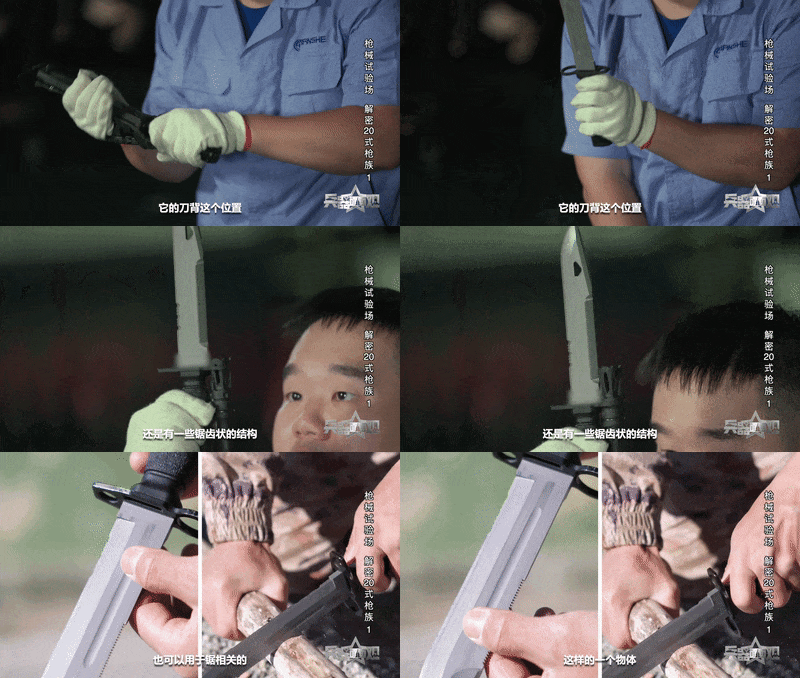
The spine of the bayonet also features a serrated structure,
which can be used to saw through objects,
open cans, or bottles,
and even combine with the scabbard
to cut through wires and barbed wire.
Thus, the small bayonet can also become a “multitool”
to assist soldiers on the battlefield.
Why does our military's new generation standard rifle
extensively use engineering plastics?
Military expert Du Wenlong introduced that
the extensive use of engineering plastics
serves two main purposes:
First, to reduce weight.
When soldiers are engaged in continuous operations,
heavy firearms and other equipment can affect mobility.
Second, for tactile comfort.
In high-temperature or extreme cold conditions,
touching pure metal parts
can easily lead to burns or frostbite.

Engineering plastics have thermal insulation properties
and can also solve corrosion issues.
Replacing metal with engineering plastics
allows for effective use even in extreme conditions.
From the optimization of minute components
to extreme environmental adaptability,
and then to the iterative upgrade of materials,
the transformation of the Type 20 rifle family
is not only a breakthrough in domestic light weapon craftsmanship and technology
but also a vivid embodiment of our military industry’s alignment with real combat
and its service to strengthen the military.
This article is sourced from: CCTV News WeChat Official Account, compiled by CCTV Military.
The Chinese military introduced the new 191 automatic rifle, featuring both transparent and opaque magazines for tactical advantages. The rifle includes a bayonet, emphasizing traditional combat skills, and utilizes engineering plastics to enhance usability in extreme conditions. These developments showcase advancements in domestic weapon technology.
- The 191 automatic rifle is part of the domestic 20 series of firearms.
- It features two types of magazines: transparent and opaque.
- The rifle is equipped with a bayonet, reflecting military tradition.
- The use of engineering plastics in the rifle reduces weight and improves handling in extreme conditions.
- The design improvements represent advancements in domestic light weapon technology.