
The U.S. Marine Corps NMESIS and Japan's Ground Self-Defense Force Type 25 SSM Test Distributed Defense on Yonaguni Island in 2026
 Tanaka Takashi
U.S. Marine Corps NMESIS and Japan Ground Self-Defense Force Type 25 SSM to Test Distributed Defense on Yonaguni Island in 2026
The distance from Yonaguni Island to Taiwan is only about 110 kilometers. During the Japan-U.S. joint integrated exercise "Keen Sword 27," which will be conducted from October 19 to 29, the U.S. Marine Corps will deploy NMESIS (Naval and Marine Expeditionary Ship Interdiction System) and MADIS (Marine Air Defense Integrated System) on the island for the first time. This training is not just a showcase of equipment, but an exercise to test whether the southwestern islands can be used as a chain of mobile firepower nodes rather than a single base.
Gathering Anti-Ship and Air Defense Firepower on Yonaguni Island
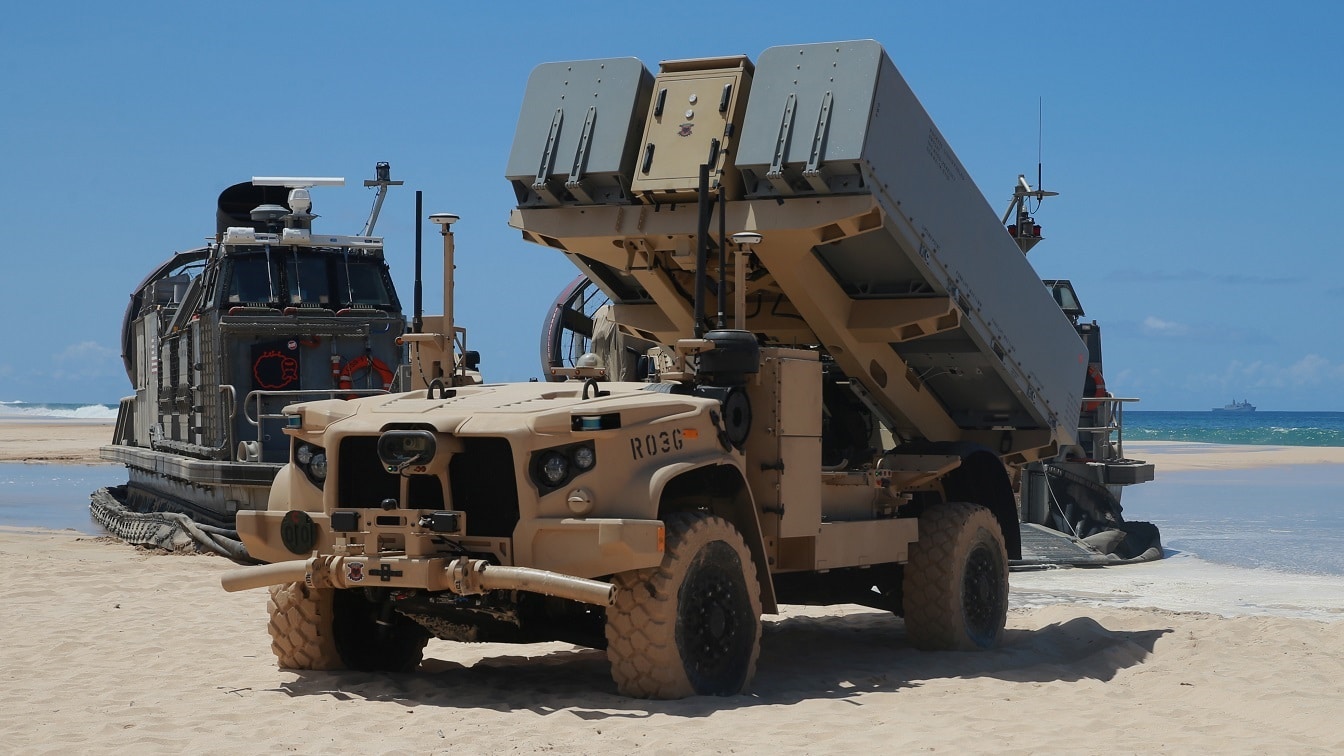
- NMESIS: A ground-launched anti-ship missile system of the Marine Corps, with a range of approximately 115 miles (about 185 kilometers).
- MADIS: A mobile air defense system that accompanies small units and is responsible for countering low-altitude threats such as drones.
- Japan Ground Self-Defense Force Type 25 Surface-to-Ship Guided Missile: An upgraded version of the old Type 12, with a range of about 1,000 kilometers. The Type 88 and Type 03 medium-range surface-to-air missile systems will also participate in the training.
According to the Ministry of Defense, approximately 45,000 Self-Defense Forces personnel and units from nine countries will participate in this exercise. The U.S. Army's HIMARS is also expected to be deployed on Ishigaki Island, revealing the outline of a distributed deployment connecting Yonaguni, Ishigaki, and Okinawa Main Island.
Changes in the Exercise Indicated by the Absence of Aircraft Carriers
In previous Keen Sword exercises, aircraft carrier strike groups often served as the visual center. However, this time, the participation of the USS George Washington is not anticipated, and ground-launched firepower will take the forefront. While the U.S. Navy's "Pacific Vanguard 26" integrated Japan's escort ships, submarines, and P-1 patrol aircraft into a multilateral maritime network, Keen Sword 27 aims to pass that information to the island-based missile units and move to a stage where firing positions are frequently changed.
It is necessary to separate capabilities from intentions. The deployment of NMESIS demonstrates the ability to deny access at sea in the event of a crisis in Taiwan, but in peacetime, it also serves as a deterrent signal against Chinese vessels. On the other hand, being mobile means that fuel, ammunition, communications, and resupply must be maintained across fragmented islands.
The Real Test Lies in Ports and Roads
Large equipment will be transported from Kubura Port, and residents are being asked to refrain from using the roads. Even if the island's radar and missile launchers are high-performance, if transportation from the port to firing positions is monitored and exceeds the capacity of civilian infrastructure, distributed defense will not be established. The concerns expressed by Yonaguni Town regarding large-scale exercises are not merely political opposition but a realistic warning about operational continuity.
According to Takashi Tanaka, the focus this time is not on the range of the Type 25 SSM. It is about whether Japan and the U.S. can share target information in the same maritime area, make launch decisions, and measure the speed of withdrawal and redeployment from the island. As the range increases, the risk also rises that our supply lines and decision-making will be discovered before the enemy's vessels. The weakness in the defense of the southwestern islands may not be a lack of firepower, but rather the remaining need for civilian transport and political maneuverability to leverage that firepower.
Sources
The U.S. Marine Corps deployed NMESIS and MADIS systems on Yonaguni Island as part of the joint military exercise 'Keen Sword 27' from October 19 to 29, 2026. Approximately 45,000 Self-Defense Forces personnel and units from 9 countries participated, testing distributed defense capabilities. The exercise emphasized ground-launched firepower, with the Type 25 SSM having a range of 1,000 kilometers, while logistical challenges were highlighted due to the reliance on civilian infrastructure for transport.
- The U.S. Marine Corps will deploy NMESIS and MADIS systems on Yonaguni Island during the exercise.
- The exercise involves approximately 45,000 Self-Defense Forces personnel and units from 9 countries.
- The Type 25 SSM has a range of approximately 1,000 kilometers.
- The exercise aims to test distributed defense capabilities across multiple islands.
- The absence of an aircraft carrier marks a shift in the exercise's focus towards ground-launched firepower.