
Analysis & Reports
AI-assisted analysis of military-related information from public sources
Updating Navy warships at the speed of software
The U.S. Navy is enhancing its combat capabilities by implementing over-the-air software updates for systems aboard ships, allowing for rapid adaptation and improved operational effectiveness. This initiative supports the Navy's strategy to maintain an edge against dynamic threats and emphasizes the importance of software fluency in modern warfare. The updates enable ships to operate with improved software while at sea, significantly reducing the time required for system enhancements.

Air National Guard offers $7,500 bonuses for active duty transfers
The Air National Guard is offering $7,500 bonuses to active duty airmen to encourage transfers into state units for three years of service. This initiative is part of a broader recruiting strategy aimed at adding nearly 11,580 airmen by 2026. Additionally, the Air Guard is restructuring its recruiting command and launching a marketing campaign to highlight the benefits of guard service.

Trump Says the Strait of Hormuz Is ‘Sort of Open Right Now’ — Tehran Calls It ‘a New and Different Model’ Instead
Iran and Oman have established a framework for a temporary agreement on the Strait of Hormuz, with Iran managing incoming shipping and Oman managing outgoing traffic. This agreement, however, does not fully reopen the waterway, as stated by Iranian officials. The deal is expected to be followed by further discussions involving the U.S. and the United Nations regarding Iran's nuclear program and other disputes.

Iran Is About to Win the War Trump Started
Iran is negotiating for control over the Strait of Hormuz, which would allow it to regulate maritime traffic and exclude U.S. and Israeli vessels. The U.S. military has used most of its long-range precision missiles in the conflict, and Iran's missile capabilities remain operational. Supreme Leader Mojtaba Khamenei's approval is required for the agreement, which could formalize Iranian control over the strategic waterway.
 Alexandra ReevesFri Aug 07 2026Loading...
Donald Trump Lost the Iran War
The U.S. military has been cannibalizing its stockpiles to sustain operations in Iran since February 28, 2023, amid ongoing conflict. Despite initial claims of success, Iran retains significant missile capabilities and control over the Strait of Hormuz, impacting global oil supplies. The U.S. has not achieved its objectives, and public opposition to the war is growing due to a lack of clear justification from the administration.

On 12 July a Submarine Britain Sold to Canada for £1 Fired the Torpedo That Sank a Decommissioned US Navy Cruiser
On July 12, 2026, HMCS Corner Brook of the Royal Canadian Navy fired an Mk 48 heavyweight torpedo, successfully sinking the decommissioned USS Mobile Bay during the RIMPAC exercise. This action highlights the operational capabilities of the Upholder-class submarines acquired from Britain.

A US Marine KC-130F Hercules Landed on US Navy Aircraft Carrier USS Forrestal 21 Times in 1963. No Arresting Gear, No Catapult, and Nobody Has Tried It Since
A US Marine Corps KC-130F Hercules successfully conducted 21 full-stop landings and 21 unassisted takeoffs on the USS Forrestal from October 30 to November 22, 1963, in the North Atlantic. This operation was notable for being the largest aircraft to land on a carrier without tailhook or catapult assistance. Despite the success of the tests, the Navy decided against routine operations due to operational risks.

Why 500,000 G95 Assault Rifles Won't Solve the Bundeswehr's Personnel Problem
The Bundeswehr plans to double its order of G95 rifles to 500,000 units while struggling with personnel shortages, currently at 184,000 active members. The expansion of reserve forces aims to increase from 60,000 to 200,000 by the mid-2030s. However, the active troop target of 260,000 remains distant, highlighting a significant gap between equipment procurement and personnel availability.
 Dr. Klaus WeberFri Aug 07 2026Loading...
Everyone Says US Navy Nuclear Submarine USS Dallas “Sank” Aircraft Carrier HMS Illustrious in 2013. The Royal Navy Record Confirms the Attack But No ‘Kill’
USS Dallas conducted simulated torpedo attacks against HMS Illustrious during a naval exercise in the Gulf of Oman in 2013. The exercise involved multiple naval units, including the Type 23 frigate HMS Westminster and the destroyer USS Bulkeley. Although the Royal Navy confirmed the simulated attacks, no official ruling declared the carrier as 'sunk'.

Rheinmetall says ramping up ATACMS output will take time as US rebuilds stocks
Rheinmetall plans to ramp up production of ATACMS missiles in collaboration with Lockheed Martin at its Unterluess plant in Germany to address U.S. military stockpile shortages caused by the conflict with Iran. Production facilities are set to be established next year, with revenue expected by 2028. The company also anticipates a significant contract for Boxer armored vehicles with the German military by the end of the year.
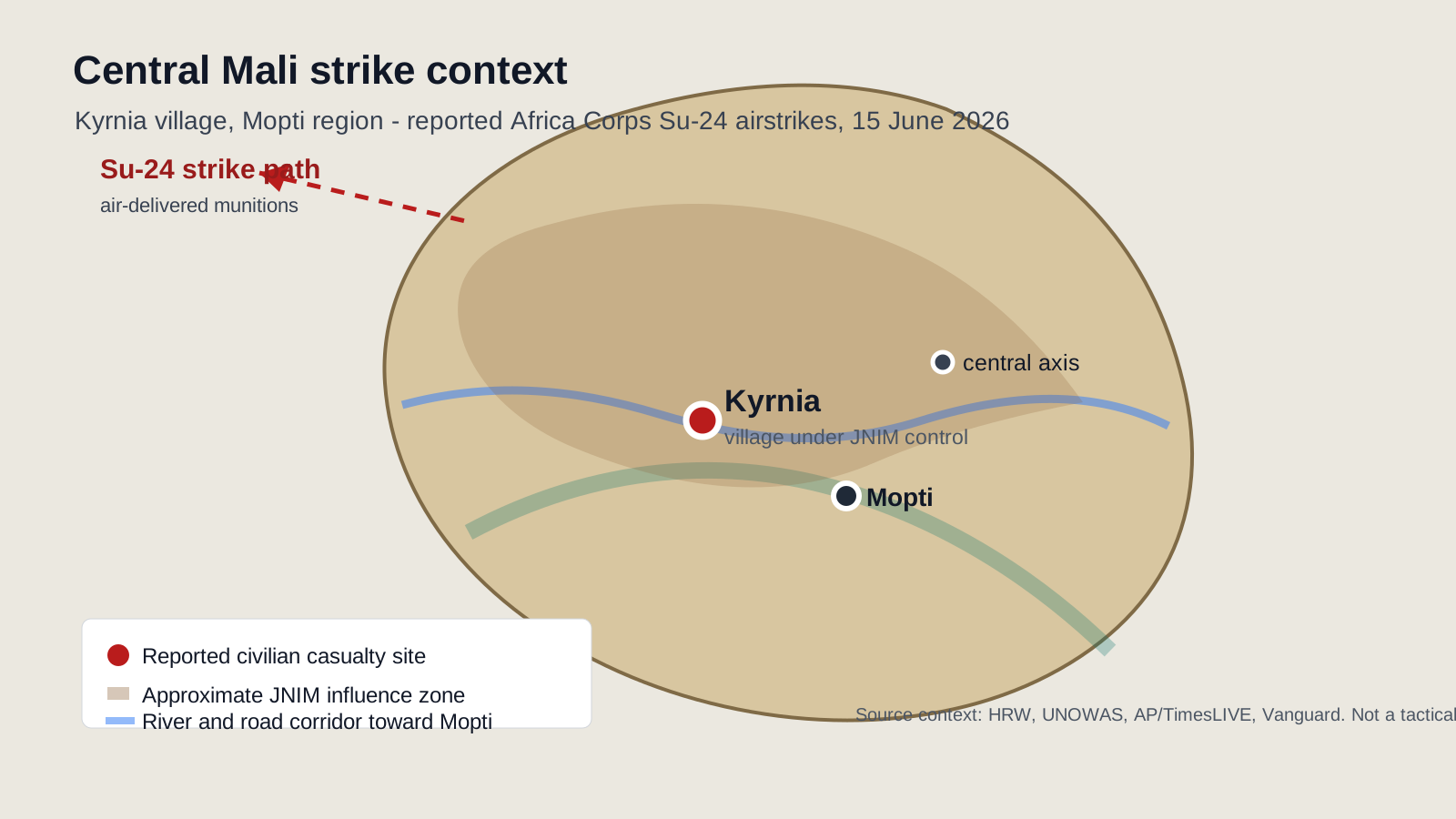
After the fall of Kidal, Moscow secures the Sahel with an expanded military pact
On July 31, 2026, Russia expanded its military cooperation with the Alliance of Sahel States (AES) during a meeting in Niamey, involving 5,000 to 6,000 personnel. This agreement extends beyond military assistance to include economic and financial collaboration. The Russian African Corps is solidifying its presence in the region, while the security situation continues to worsen due to jihadist threats and the complete withdrawal of French forces from central Sahel.
 S.WFri Aug 07 2026Loading...
Not Made in the USA: Japan’s 72,000 Ton Yamato-Class was the Biggest Battleship Ever but the US Navy’s Iowa-Class Would Have Sunk Them
The U.S. Navy's Iowa-class battleships demonstrated superior operational effectiveness compared to Japan's Yamato-class during World War II. Despite Yamato's larger size and heavier armament, Iowa's advanced radar fire control and higher speed provided significant tactical advantages. The Iowa-class ships successfully adapted to the evolving naval warfare landscape, while Yamato's capabilities were underutilized in the war's context.
The Brigade of Prisoners of War — The Personnel Despair of the Russian Ministry of Defense Crosses Red Lines
The Ukrainian Volunteer Corps formed the first Ukrainian volunteer special forces brigade from Ukrainian prisoners of war on August 6, 2026, amid significant personnel losses in the Russian army. This formation reflects a deepening crisis within the Russian military, which reportedly loses up to 40,000 personnel monthly. The practice of using POWs in combat roles raises serious legal and ethical concerns, highlighting the ongoing violations of international humanitarian law.
S.WFri Aug 07 2026Loading...
Aircraft Carriers, Nuclear Submarines, F-35, F-22 and Even New F-47 Fighters Won’t Guarantee the US Military Wins Wars
The Pentagon is expanding production of missile components and adapting military strategies to include a mix of expensive and affordable systems. On July 10, the U.S. Air Force's YFQ-44A Collaborative Combat Aircraft fired an AIM-120 over the Mojave Desert. Additionally, the first production MQ-25A Stingray flew in April 2023, aimed at extending the range of carrier air wings. The U.S. plans to acquire over 150 combat-capable aircraft by the end of the decade, reflecting a shift in military strategy.
Saudi Arabia, Turkey, Pakistan ink ‘joint defense’ agreement
Saudi Arabia, Turkey, and Pakistan signed a joint defense agreement in Mecca, establishing a NATO-style collective defense alliance. The agreement stipulates that any armed attack against one of the states will be viewed as an attack against all. This initiative aims to strengthen defense cooperation and collective security among the three nations amid rising regional tensions, particularly from Iran-backed forces.

The US Navy Will Retire 97,000 Ton Nuclear Aircraft Carrier USS Nimitz in 2027. No One Knows How Much It Will Cost or How Many Years It Will Take
The USS Nimitz is set to retire from active service in March 2027, with an initial budget of $562 million allocated for its inactivation. The U.S. Navy plans to gradually reduce the crew to 600 sailors by fiscal 2030 as the ship undergoes disposal processes at Newport News Shipbuilding, including defueling and removal of sensitive materials. The entire disposal project is expected to take several years.

U.S. Army orders more Israeli-designed suicide drone drones
The U.S. Army placed an additional order exceeding $50 million for HERO 120 loitering munition systems following successful Lot Acceptance Tests. This order aims to enhance the number of systems and supporting equipment available to soldiers, reflecting the Army's commitment to integrating advanced unmanned weaponry into its operations. Mistral Inc. and Uvision are the primary contractors for this program, which is part of a broader effort to improve precision strike capabilities.

Eaton turns heavy military trucks into hybrid
Eaton Corporation showcased a fully electrified Medium Tactical Vehicle Replacement demonstrator that operates silently on battery power during the Ground Vehicle Systems Engineering and Technology Symposium in Novi, Michigan, from August 11-13, 2026. This vehicle, developed for the U.S. Marine Corps, features a hybrid propulsion system and can export electrical power for field operations, enhancing tactical mobility and logistics efficiency.

14,700 Shells Fired: The US Navy Iowa-Class Battleships Wore Out Their 16-Inch Barrels in the Korean War. The Replacements Came From Ships That Were Never Built.
Four Iowa-Class battleships, including USS Missouri and USS New Jersey, conducted bombardment operations in Korea from September 1950 to July 27, 1953, firing over 14,700 16-inch shells. USS New Jersey suffered a direct hit, resulting in one sailor's death, while USS Wisconsin was also hit, injuring three sailors. The battleships focused on targeting coastal infrastructure and supporting United Nations forces.

Poland’s defense industry seeks role in Europe’s missile shield
Polska Grupa Zbrojeniowa (PGZ) is convening a meeting on August 13, 2026, in Poland to explore the defense industry's role in Europe's missile defense capabilities. The meeting aims to identify how Polish companies can contribute to the European ballistic missile defense program, following a joint declaration that established the Anti-Ballistic Missile Coalition. Poland is also set to host the coalition's first joint military exercises this autumn.


